
Guides
EXIST Forschungstransfer Phase I vs Phase II: what each phase funds and how to plan the bridge
Forschungstransfer is two grants in a trench coat. Phase I de-risks the research; Phase II funds the company. Plan both from the start.

Key takeaways
Locate your core risk
Ask whether the riskiest open question in your venture is scientific/technical or execution/market. That answer largely decides Forschungstransfer vs Gründerstipendium.
Map the research-to-product gap for Phase I
Write what scientific result you build on, what is still unproven about making it a product, and the work packages that close that gap inside Phase I.
Sketch the formation handover early
Outline the legal form, IP assignment from the university, and founder shareholdings for the spin-off. Get legal and tax advice on this before Phase I ends.
Plan Phase II as a company-funding case
Draft the Phase II story as go-to-market plus financing beyond the grant, contingent on Phase I delivering its results. Remember it is a separate application.
Forschungstransfer is not the Gründerstipendium with a bigger budget
The most common misunderstanding is treating EXIST Forschungstransfer as a heavier version of the EXIST Gründerstipendium. They are different instruments for different situations. The Gründerstipendium funds individuals - a small founding team gets personal stipends for a year to turn an idea into a startup. Forschungstransfer funds the transfer of a substantial, often years-long research result out of a university into a company, and it does so in two distinct phases with a company formation in the middle. If your venture is essentially a good product idea with a loose university link, the Gründerstipendium is almost certainly the right track. Forschungstransfer is for ventures where the core asset is a research result that still needs significant development work to become a product - where the technical risk is real and the research lineage is central.
Because the two phases sit either side of company formation, Forschungstransfer is also a bigger commitment and a longer arc than the Gründerstipendium. You are not planning a one-year sprint; you are planning a multi-year transfer with a defined handover point. Teams that succeed with it plan both phases from the start, even though Phase II is applied for separately and is not guaranteed by a Phase I award.
Phase I: de-risk the research, before the company exists
Phase I funds a research-oriented team, typically embedded at the host university, to do the development and proof work that turns a research result into something investable. This is the phase for technical de-risking: building a robust prototype, validating the core scientific claim at a relevant scale, clarifying the IP situation, and testing the first market assumptions. Crucially, in Phase I there is usually no company yet - the work happens under the university's roof, with the team funded to mature the technology and prepare the spin-off. The deliverable of Phase I is a venture that is ready to incorporate: a proven core, a clear IP path, a credible business case, and a team that has decided to start the company.
Write the Phase I application around the research-to-product gap. Reviewers want to see what scientific result you are building on, who owns it, what specifically is unproven about turning it into a product, and how your phase plan closes that gap. The closer your team sits to the original research - ideally including the researchers who produced it - the stronger the application, because Forschungstransfer is fundamentally a transfer-of-people-and-knowledge instrument, not just a transfer-of-IP one.
Phase II: fund the company through early development
Phase II picks up after the company is incorporated. Where Phase I de-risked the research inside the university, Phase II funds the young company to take the de-risked technology toward the market: further development, building out the team, the first commercial steps. The funding shape changes accordingly - Phase II supports the company and its activities rather than a university-embedded research team. This is the phase where the venture genuinely becomes a business, and the application is judged more like a company-funding case: a credible go-to-market, a financing plan beyond the grant, and evidence the Phase I work delivered what it promised.
Two planning realities matter here. First, Phase II is applied for separately and is not automatic - a Phase I award does not guarantee Phase II funding, so the Phase I work has to actually produce the results that make a strong Phase II case. Second, the handover between phases includes the company formation itself, which carries its own legal and tax decisions (legal form, IP assignment from the university, founder shareholdings). Plan that handover early and get proper legal and tax advice for it; the formation is not a formality you can improvise between two grant phases.
The six steps into Phase II at a glance
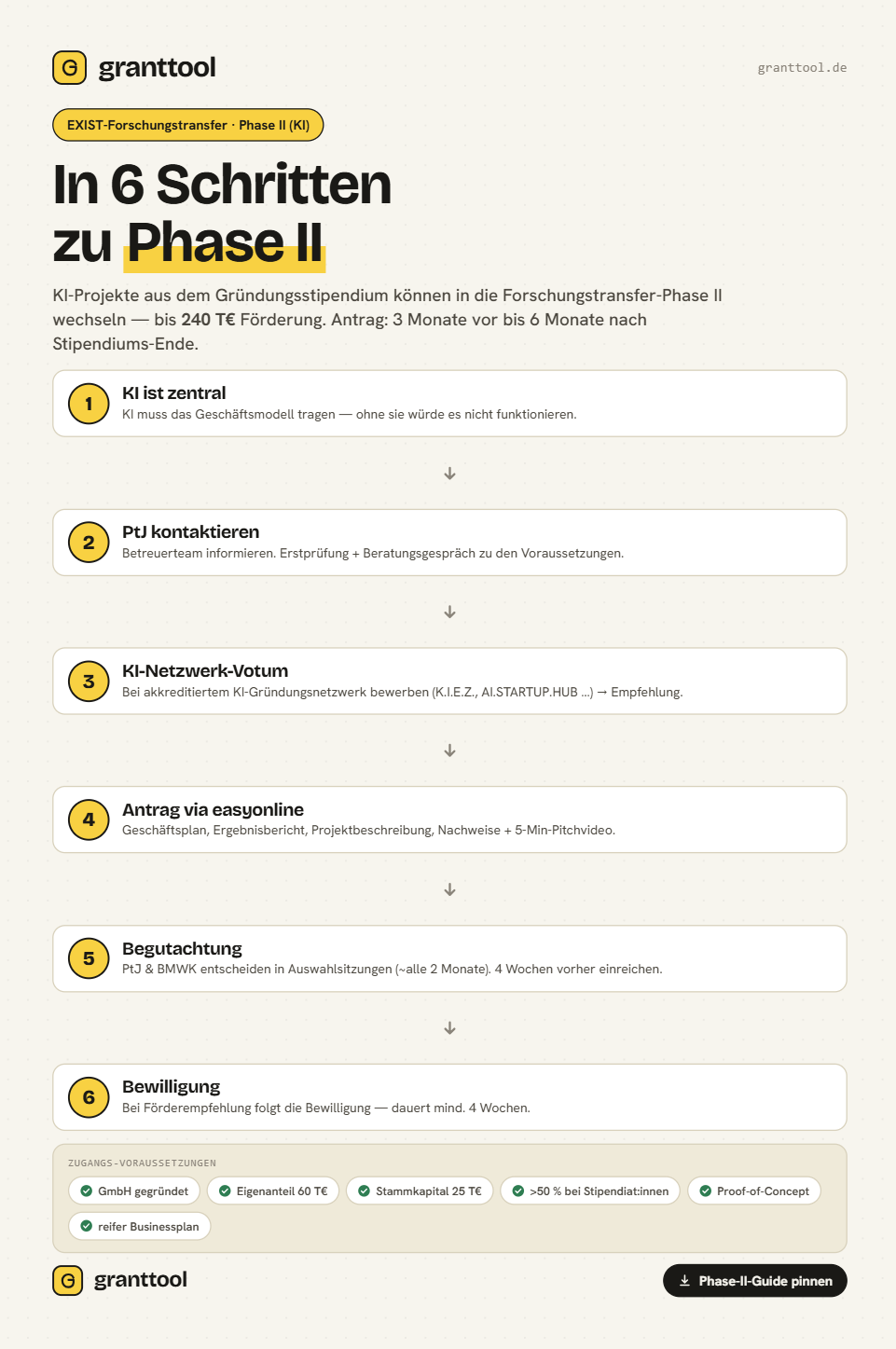
Moving from the Gründerstipendium into Forschungstransfer Phase II runs through six steps — make the tech central, contact the PtJ, line up the consortium, file via easy-Online, get through the Begutachtung, and reach the Bewilligung. The window typically opens three months before to six months after the stipend ends. This infographic maps the handover on one page.
 Download
Choosing your track, and writing for the phase you are in
Decide the track honestly before you write a word. If the core risk in your venture is execution and go-to-market, and the technology is essentially ready, the Gründerstipendium is faster and lighter and you should not over-reach into Forschungstransfer just because the budget is bigger - reviewers see straight through a thin research story dressed up for a research-transfer programme. If the core risk is genuinely scientific or technical and the asset is a real research result that needs maturing, Forschungstransfer is built for you and the Gründerstipendium would under-fund the work.
Once you have chosen, write for the phase in front of you while keeping the whole arc visible. A Phase I application that shows you have already thought about the company formation and Phase II reads as a team that understands the journey; a Phase I application that treats Phase I as the whole story reads as short-sighted. Equally, do not over-promise the company side in Phase I - the Phase I deliverable is a fundable, formable venture, not a finished business. Match the claims to the phase, and let the plan show you know which phase you are in.
The Phase II business-plan chapters at a glance
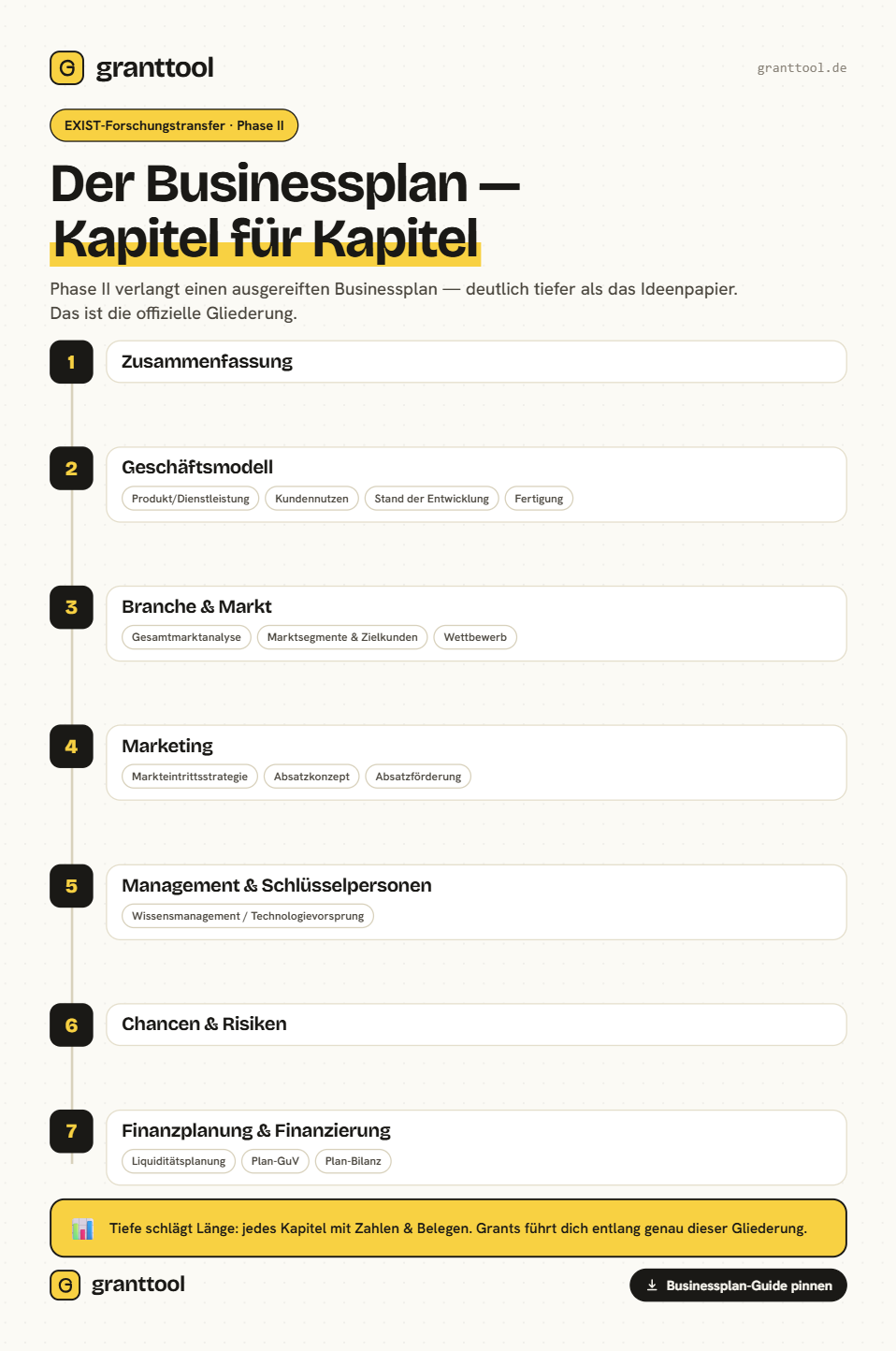
Phase II is judged like a company-funding case, and the business plan it expects is fuller than the Phase I idea paper — seven chapters from summary and business model through market, marketing, management, opportunities and risks, to financial planning. This infographic shows the full chapter skeleton on one page.
 Download
FAQ
Frequently asked
Try Grants
Free plan, no credit card. We host in Germany. You can export and delete everything self-serve.
Read next
EXIST Forschungstransfer: the two-phase grant for spin-offs from research
Phase 1 + Phase 2 budgets, eligibility, and how reviewers decide.
Read
IP and Schutzrechte in the application: what to claim, what to file, and the university question
Patents vs other moats, the university IP-assignment question, and how to write the IP section.
Read
IGP or EXIST? How to choose the right early-stage grant for your venture
Eligibility, what each funds, and the decision tree.
Read
EXIST funding: the complete guide to the Gründerstipendium and Forschungstransfer
The central EXIST overview: variants, eligibility, amounts, the application path, and every step's deep-dive guide in one hub.
Read