
Guides
EXIST Forschungstransfer: the two-phase grant for spin-offs from research
Up to €2.25M over up to 4.5 years to take university tech from lab to market. Larger, slower, and stricter than the Gründerstipendium.
Key takeaways
Confirm the research origin and proof of principle
The project must originate from a research project at a German university or institute, with at least basic feasibility already shown (TRL 3+). No research origin, no Forschungstransfer.
Anchor at the Gründungsnetzwerk and secure a mentor
Your host applies for you, so engage its Gründungsnetzwerk early and secure a professor or group leader as mentor plus lab/infrastructure access. Clarify IP terms before approval.
Write the ~50-page Phase 1 proposal
Cover the scientific-technical concept, the commercialisation concept, a milestone work plan, risk analysis, and a detailed budget. Letters of support from at least three potential customers strengthen it materially.
Submit via easy-Online to PtJ and present to the jury
File electronically plus a signed original (forms AZA/AZV/AZK) before a cutoff (31 March, 31 August, 30 November). After PtJ's review, present to the Expertenjury; the decision rests with the BMWK - no outcome is guaranteed.
Found the GmbH and apply for Phase 2 in the window
Incorporate the GmbH (≥€25k paid-in Stammkapital, founders holding >50%) and arrange the own contribution (~1:3 to the grant). File the Phase 2 application about 6 months before Phase 1 ends, at the latest up to 6 months after.
Why two phases
EXIST Forschungstransfer is designed for research-derived technology that is not yet ready to leave the lab. Phase 1 covers the technical hardening - additional development, IP clearance, market validation - while you stay inside the university. Phase 2 starts after the GmbH is founded and funds product, market entry, and team. Phase 1 success does not guarantee Phase 2 - you re-apply with a sharper business case.
Phase 1 vs Phase 2: the money, corrected
A common myth puts Phase 2 at '€2M over 3 years'. The binding 2024 Förderrichtlinie says the opposite: the larger, longer phase is Phase 1, and Phase 2 is the smaller seed grant. Phase 1 funds up to four full-time-equivalent positions plus up to €250k of Sachmittel, regularly over 18 months and up to 36 in justified, jury-approved cases - which is where the seven-figure totals come from. Phase 2 is a non-repayable Gründungszuschuss capped at €180k (and at 75% of project costs), regularly 18 months, paid to the founded GmbH. Treat any figure you read elsewhere with care and confirm against the current Handbuch.
Eligibility
Phase 1 applicants must be a research group at a German university or research institute. The group typically includes a professor as principal investigator, postdocs as future founders, and the Gründungsbüro as administrative anchor. The technology must have at least TRL 3 (experimental proof of concept) and be on a credible path to TRL 7 by end of Phase 2.
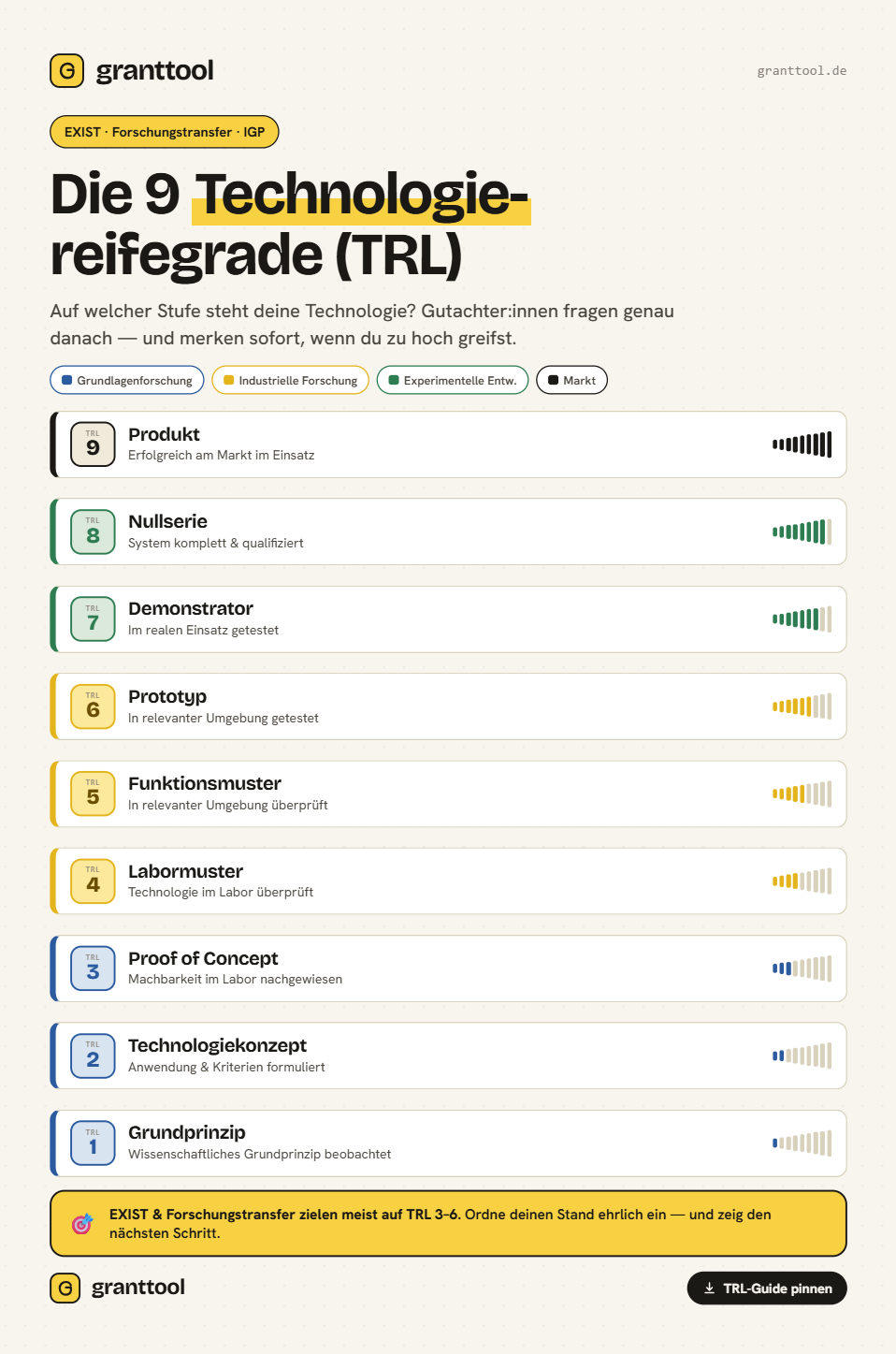
The nine Technology Readiness Levels (TRL)
Forschungstransfer reviewers ask exactly which TRL your technology sits at — Phase 1 expects at least TRL 3 (experimental proof of concept) on a credible path to TRL 7 by the end of Phase 2. This infographic lays out all nine levels from basic principle (TRL 1) to finished product (TRL 9) so you can place your own technology before you write.
 Download
What to submit
A project proposal of ~50 pages covering: scientific-technical concept (state of the art + your innovation), commercialisation concept (market + business model + IP), work plan with milestones across 18 months, risk analysis, and detailed budget. Letters of support from at least three potential customers strengthen the case materially.
Timeline and decision
Submission is continuous, but Phase 1 applications are evaluated in rounds with cutoffs on 31 March, 31 August, and 30 November each year. Plan roughly 5-6 months from submission to decision - longer than the Gründerstipendium because of the live Expertenjury for Phase 1 - with the result typically communicated within about three months of the cutoff. The Phase 2 application has its own window: file it about 6 months before Phase 1 ends, and at the latest up to 6 months after Phase 1 ends. A seamless, immediate hand-off is not possible, so build cash runway for the gap.
Own contribution and Stammkapital in Phase 2
Phase 2 surprises many teams: the grant is not free money on its own. The €180k Gründungszuschuss covers at most 75% of project costs, and the company must finance the rest with its own funds - founders' equity plus, where applicable, participation capital - in roughly a 1:3 ratio to the grant. Against the €180k maximum that means at least about €60k of own or investor capital. On top, the GmbH must already exist before Phase 2 with at least €25,000 of paid-in Stammkapital, and more than 50% of shares held by founders working in the company. Plan the follow-on financing early; this is no tax or legal advice.
People and salaries
Phase 1 funds up to four full-time-equivalent positions for the founding team, at least one of which must bring business or entrepreneurial competence, plus student and scientific assistants. Salaries follow the host institution's pay grades rather than a statutory TV-L rate - effectively band-aligned. In Phase 2 the Phase-1 founders are paid 'in Anlehnung an die jeweiligen Gehaltseingruppierungen' alongside new hires, and a flat overhead surcharge of up to 90% on direct personnel costs covers things like travel rather than booking them as separate line items.
IP and exploitation: what the funder keeps
Results - inventions, prototypes, software - belong to the recipient with an exclusive right of use, but the strings matter. Before approval you must submit an Absichtserklärung on using the institution's IP, since the host has to be willing to grant the spin-off access at market-standard terms. If you earn exploitation revenue during the funding period, the Bund participates proportionally up to the amount of the grant, and selling or transferring the R&D results in that period needs prior funder approval. The funder also keeps a non-exclusive right of use for cases of overriding public interest, and can ask for a short commercial-development report for up to five years after funding ends. This is no legal advice - read Anlage A of the Richtlinie and clear the details with your Gründungsbüro.
The application process, concretely
Your host university applies on your behalf - it must be embedded in a Gründungsnetzwerk that acts as your central contact point. Submission runs through the easy-Online portal plus one signed paper original, using the AZA/AZV/AZK forms, to Projektträger Jülich (PtJ) in Berlin. PtJ assesses the application formally and on content, optionally with external Gutachter:innen; if positive, the founders present to a BMWK-appointed Expertenjury before the ministry decides. For Phase 2 the jury can be waived if the Phase-1 goals were met. Compared with the EXIST Gründerstipendium, the heavier proposal and the live jury are what make Forschungstransfer slower.
FAQ
Frequently asked
Try Grants
Free plan, no credit card. We host in Germany. You can export and delete everything self-serve.
Read next
EXIST Gründerstipendium: everything you need before you apply
Eligibility, amounts, what to submit, and the real timeline.
Read
EXIST Gründerstipendium in numbers: 2007-2024 statistics
What 17 years of EXIST data tell us about your chances.
Read
5 common mistakes in the EXIST application – and how to avoid them
A practical checklist before you submit.
Read
EXIST funding: the complete guide to the Gründerstipendium and Forschungstransfer
The central EXIST overview: variants, eligibility, amounts, the application path, and every step's deep-dive guide in one hub.
Read