
Guides
EXIST Gründerstipendium: everything you need before you apply
BMWK funds 12 months of living allowance + €30k of project costs for university teams turning research into a startup. Here's how it works end-to-end.

Key takeaways
Check your idea against the funding logic
EXIST funds innovative, knowledge-based ideas with a university link, a team of up to three, and no operating company yet. Confirm you fit before investing weeks in the Ideenpapier.
Contact the university Gründungsbüro
Reach out 4-6 weeks before you want to submit. The Gründungsbüro gives an honest first read on fit and is the body that files the formal application for you.
Find a mentor
Secure a professor in a fitting field who commits to mentoring plus access to infrastructure. Structurally, EXIST is a Hochschul-Antrag - no mentor, no application.
Write the Ideenpapier
Use the official Gliederungsvorschlag from exist.de (max 15 pages, Arial 12pt, 1.5 line spacing). Cover idea, innovation, market, team, plan, risks, funding need. Plan 6-8 weeks.
Present to the Gründungsnetzwerk
The network vets the Ideenpapier informally first (team fit, innovation, market) before the formal route opens. Use the feedback loop.
Assemble the formal documents
Application form (fill it in Adobe Acrobat Reader - other readers corrupt it), CVs, cooperation agreement, mentoring commitment. The university uploads everything as PDF to easy-Online at Projektträger Jülich (no postal route).
Review and decision
An independent jury reviews for up to ~12 weeks. On approval the university issues the Zuwendungsbescheid; the stipend then runs through the university, typically starting ~3 months after submission. The decision rests with the jury - no outcome is guaranteed.
What EXIST Gründerstipendium funds
Twelve months of personal living allowance per founder, scaled by qualification: ~€1,000/month for students, ~€2,000 for technical staff, ~€2,500 for graduates, ~€3,000 for PhDs. On top of that, Sachmittel (material expenses) up to €30,000 for teams or €10,000 for solo founders, plus €5,000 in coaching. The grant is taxable as personal income but explicitly not a loan - it does not have to be paid back.
Who can apply
Teams of up to three founders. At least one must be a graduate (within the last 5 years) or current student of a German university. Technical staff at universities qualify too. International candidates need a residence permit allowing self-employment in Germany. PhDs are eligible. Founders who already have an operating GmbH disqualify the team.
What you submit
An Ideenpapier of 10-15 pages (formats vary by university but ~27 pages of content max is standard at TUM, Arial 12pt, 1.5-zeilig). Seven sections: idea, innovation, market, team, plan, risks, funding need. A signed cooperation agreement with your university (your mentor + Gründungsbüro arrange this). The EASY-Online formal application is filed by the university, not by you.
The real timeline
From first Gründungsbüro contact to first disbursement, plan 4-5 months. Week 1-4: write the Ideenpapier. Week 5-6: internal university review + signatures. Week 7: submission. Weeks 8-19: PTJ review (~12 weeks median). Weeks 20-21: Bewilligungsbescheid + start of funding period. Build cash runway for that gap - €0 income for four months kills more applications than rejection does.
The six steps to the stipend at a glance
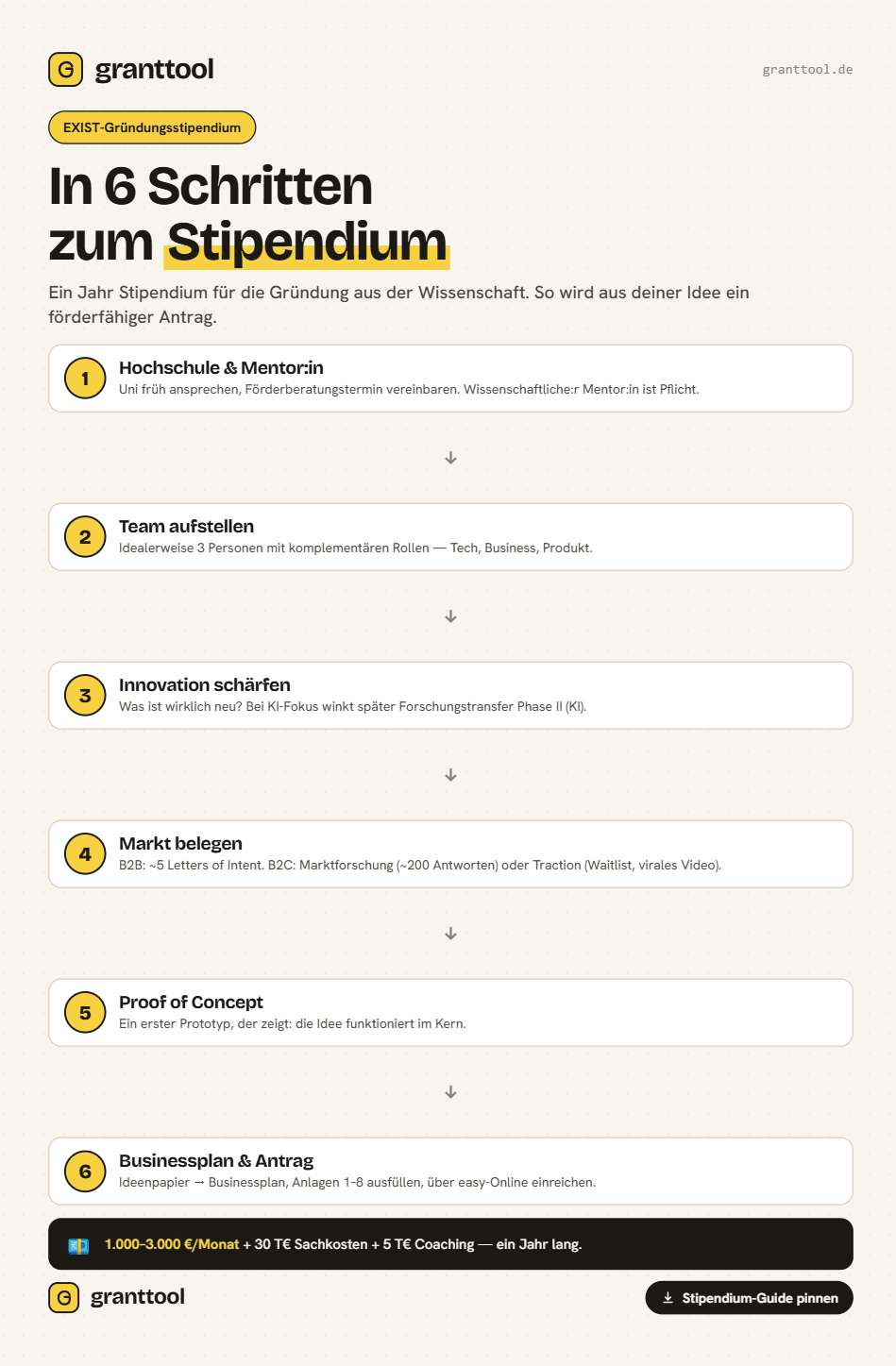
From securing your university mentor to filing the application, the path to an EXIST Gründerstipendium breaks down into six concrete steps: anchor at a university, assemble the team, sharpen the innovation, evidence the market, reach a proof of concept, then write the business plan and application. This infographic is the whole route on one page.
 Download
Common pitfalls
The four mistakes we see most: (a) tech-first opener - reviewers want the why before the how; (b) no citations in Innovationshöhe - the section dies without state of the art; (c) round-number Sachmittel ('€30,000 hardware') - line-itemed beats round; (d) no university anchor named in section 4 - structurally EXIST is a Hochschul-Antrag.
The exact amounts by qualification
The monthly stipend is fixed by qualification, not negotiated. On top of the per-founder stipend the team draws Sachmittel and coaching, and since April 2025 a one-time diversity payment for gender-mixed teams. The programme runs under ESF Plus 2021-2027; applications are accepted until 30 December 2026 (confirm the current intake window before you plan around it).
Tax and insurance during the stipend
The stipend is not tax-free. You declare it under Anlage SO (sonstige Einkünfte) - set aside roughly 15-30% for tax. You also insure yourself: with no employer, the stipend counts as income for voluntarily/privately insured founders. Enrolled students can often keep the student health-insurance rate. Your exact status is individual - clear it with your Krankenkasse and, for the tax side, a Steuerberater. This is no tax advice.
Gründerstipendium or Forschungstransfer?
Two EXIST tracks get confused. The Gründerstipendium funds the pre-foundation phase: 12 months, up to 3 people, €1-3k/month each, up to €30k Sachmittel, rolling intake. EXIST-Forschungstransfer funds deeper, research-heavy spin-offs: 18-36 months, TV-L salaries (~€5-6k), up to ~€250k, with fixed deadlines (typically March/August/November). If your project still needs substantial research before a product, Forschungstransfer is often the better fit; for a team ready to build and validate, the Gründerstipendium is the faster route. The five mistakes in a rejected EXIST application apply to both.
FAQ
Frequently asked
Try Grants
Free plan, no credit card. We host in Germany. You can export and delete everything self-serve.
Read next
EXIST funding: the complete guide to the Gründerstipendium and Forschungstransfer
The central EXIST overview: variants, eligibility, amounts, the application path, and every step's deep-dive guide in one hub.
Read
EXIST Ideenpapier: structure, length, and the seven sections that decide your application
Section-by-section template with what reviewers expect.
Read
How long an EXIST Gründerstipendium really takes (the honest 4-5 month timeline)
What every week of an EXIST application costs you - and what you can shorten.
Read
EXIST Gründerstipendium in numbers: 2007-2024 statistics
What 17 years of EXIST data tell us about your chances.
Read
Working with your Gründungsnetzwerk: the university is your co-applicant, not a stamp
How to engage the Gründungsbüro, find a mentor, and use the network's quiet edge.
Read