
Topics
EXIST Gründerstipendium in numbers: 2007-2024 statistics
5,636 applications, 3,116 approvals (55.3%), €840M disbursed, 30,000 jobs created. The dataset every founder should know before they apply.

Since 2007, BMWK has funded ~3,000 startups with more than €840 million through the EXIST start-up funding line. The 5-year survival rate of EXIST-funded ventures stands at roughly 74%.
BMWK + PTJ Monitoring 2024Applications and approvals over time
From 2007 through 2024, a total of 5,636 Ideenpapiere were submitted to the EXIST Gründerstipendium. Of those, 3,116 received funding - a long-term approval rate of 55.3%. Volumes shifted noticeably: 143 applications in the first year (2007), peaking at 423 in the pandemic year 2020 when many founders pivoted from corporate jobs into university spin-offs.
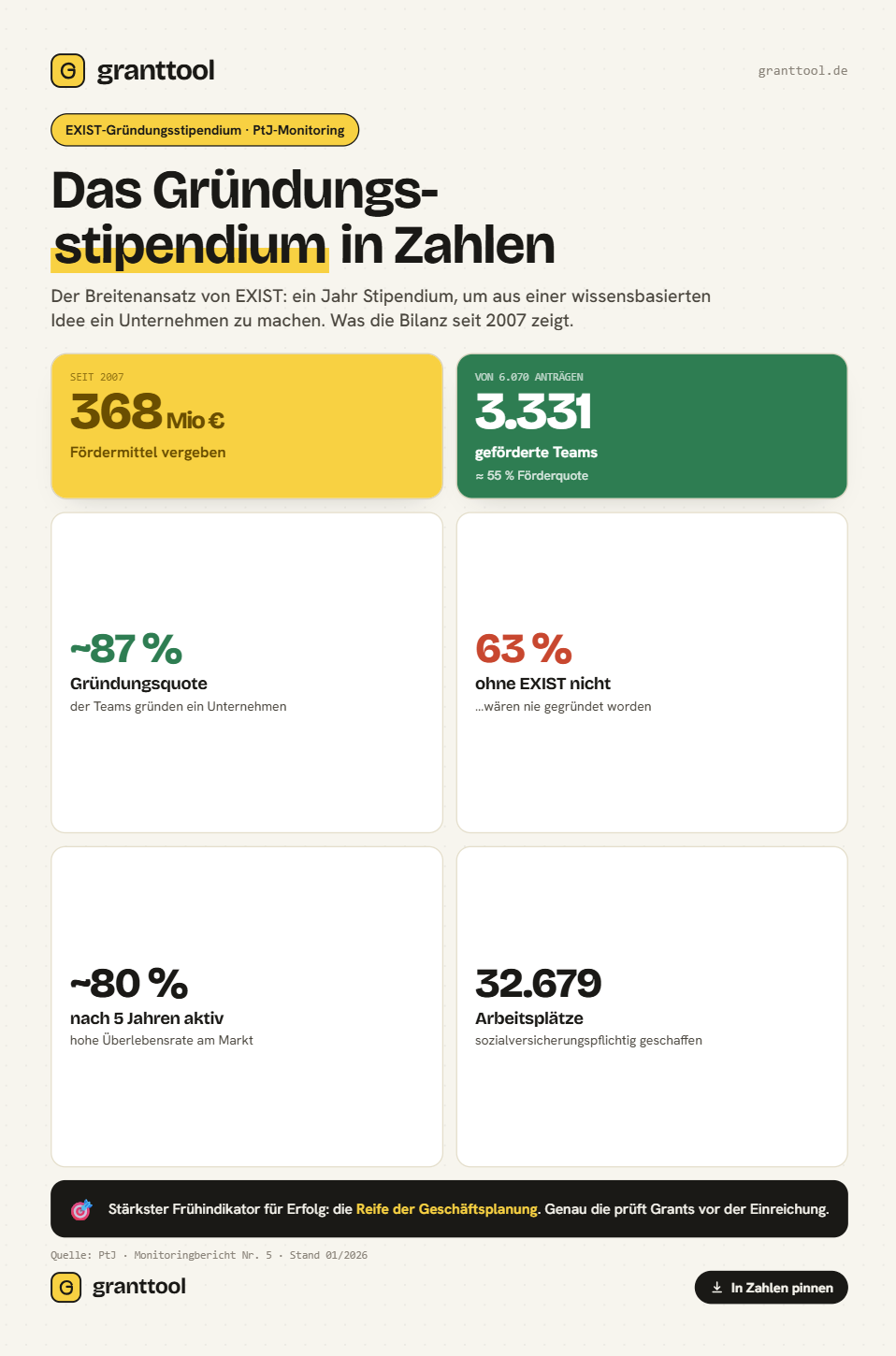
The Gründerstipendium in numbers
Since 2007 the EXIST Gründerstipendium has turned scientific ideas into companies at scale: €368M disbursed, 3,331 funded teams, around 80% still active after five years, and 32,679 jobs created — with 63% of funded founders saying they would not have founded without EXIST. This infographic puts the headline figures on one page.
 Download
Total disbursed funding
BMWK reports that since 2007 more than €840 million has flowed through the EXIST programme family (Gründerstipendium + Forschungstransfer). The yearly budget rose from ~€6.2M in 2007 to ~€10.4M by 2023 - an inflation-adjusted near-doubling that reflects political commitment to university entrepreneurship.
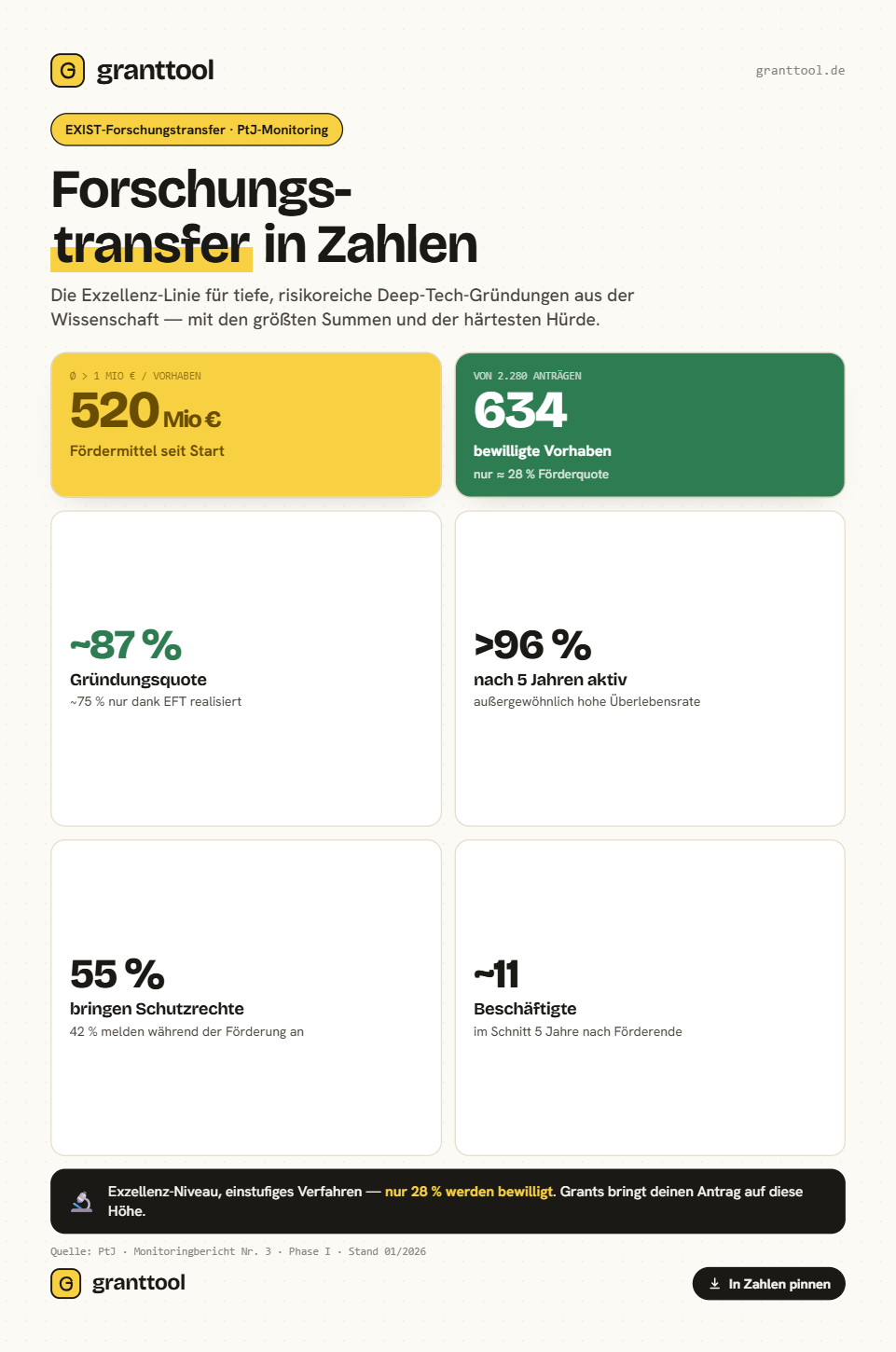
Forschungstransfer in numbers
The Forschungstransfer line is the excellence track within the EXIST family — fewer, larger, deep-tech spin-offs from research. The PtJ monitoring figures speak for themselves: €520M disbursed, 634 funded ventures, survival above 96% after five years, and the majority filing protective rights. This infographic gathers the headline numbers on one page.
 Download
Who actually gets funded
The demographic profile of EXIST-funded founders has shifted only slowly. Average age across all funding years sits at 29.9. Gender remains heavily skewed: 16.2% of stipendiates are female, 83.8% male - a number BMWK explicitly targets to move. Team composition concentrates in the upper range: 76.1% of funded teams are 3 founders, 20.2% are 2-person teams, the remainder solo founders.
Stipend amounts by qualification
The monthly stipend scales with educational background of each founder: a student receives roughly €1,000/month, a technical staff member ~€2,000, a graduate ~€2,500, and a PhD-holder ~€3,000. A typical 3-person team with mixed qualifications averages out around €6,500-7,500 of monthly stipend payouts.
Want a sharper view on your own application?
Grants compares your draft against the structural patterns of approved EXIST applications and flags where the weakest section (usually Innovationshöhe) needs more work before you submit.
What happens after the 12 months
EXIST-funded ventures show notably higher survival than the general German startup baseline. According to BMWK and the PTJ monitoring report, roughly 3,000 companies have been founded out of the programme, creating around 30,000 jobs. The 5-year survival rate sits at ~74% - well above the ~50% baseline reported for the broader German startup population.
How to read these numbers for your own application
Three signals matter. First, the long-term approval rate (~55%) is structurally friendly compared to ERC or EIC, but the year-on-year volatility (43% to 58% in just two years) means submission timing matters - quieter quarters help. Second, the gender imbalance is being actively addressed - if you are a woman or non-binary founder, look for university-specific pre-screening programmes that exist precisely to balance this. Third, the survival data justifies the EXIST runway investment - the funding meaningfully lifts post-grant survival, not just initial founding. Before submitting, read the five common EXIST mistakes to avoid the pitfalls that account for most rejections.
Sources
All numbers above are pulled from publicly available BMWK and PTJ monitoring documents. Yearly application and approval counts are derived from the 2024 EXIST Monitoring Report; cumulative figures (€840M, ~3,000 companies, ~30,000 jobs) come from the BMWK Schlaglichter article of March 2025. Demographic breakdowns trace to the PTJ longitudinal study of 2023.
FAQ
Frequently asked
Try Grants
Free plan, no credit card. We host in Germany. You can export and delete everything self-serve.
Read next
EXIST Gründerstipendium: everything you need before you apply
Eligibility, amounts, what to submit, and the real timeline.
Read
Why 44.7% of EXIST applications get rejected (and what makes the 55% that pass)
Read this before you submit, not after.
Read
EXIST Ideenpapier: structure, length, and the seven sections that decide your application
Section-by-section template with what reviewers expect.
Read
EXIST funding: the complete guide to the Gründerstipendium and Forschungstransfer
The central EXIST overview: variants, eligibility, amounts, the application path, and every step's deep-dive guide in one hub.
Read