
Guides
EXIST Ideenpapier: structure, length, and the seven sections that decide your application
The Ideenpapier is the part of the EXIST application reviewers actually read first. Get the structure right and the rest follows.

Key takeaways
Week 1: Idea + Innovationshöhe
Write the idea section first because it sets the frame for everything else. Spend the rest of week one on Innovationshöhe with citations - this is the section that decides borderline applications.
Weeks 2-3: Market + Team
Talk to potential customers (target: ten 30-minute calls). Quote them in the application. Bios with role anchoring, not chronology - reviewers want to know what role each founder plays.
Week 4: Plan + Risks + Funding
Twelve-month plan, three named risks, line-itemed funding need. Spend evenings on the formatting - reviewers reject for sloppy formatting more often than the 2024 EXIST monitoring report admits.
Week 5: Pre-submission review
Two outside reads from people who have submitted EXIST before. The Gründungsbüro of your university is the cheapest source of senior eyes. Submit by Friday, give yourself a buffer for the inevitable typo find.
What reviewers actually look for
PTJ reviewers read fifty Ideenpapiere a month. They open yours with three questions in mind: is the innovation real, is the team capable, is the budget plausible. Everything in the document either answers one of those questions or it is filler. Your job is to make the answers obvious in the section headings, the topic sentences, and the figures.
Section 1 - Idea (1-2 pages)
Open with a one-paragraph description a non-technical reader can follow. Then a problem statement and a target customer. Resist the urge to start with the technology - reviewers need the why before they trust the how.
Section 2 - Innovationshöhe (2-3 pages)
This is the section that decides borderline applications. Two things must land: (a) what you do that no existing solution does, and (b) why that gap matters technically or economically. Citations to a state of the art (papers, competitor products, patents) are not optional - they are how reviewers verify the claim. A weak Innovationshöhe section is the most cited rejection reason in the 2024 EXIST Monitoring Report.
Section 3 - Market (2-3 pages)
TAM/SAM/SOM with citations. Three reference customers (or one LoI) you have actually spoken to, with what they said. Reviewers know that fresh teams have not yet sold anything; they want to see that you have left the building, not that you have closed deals.
Section 4 - Team (1-2 pages)
Three role-anchored bios: technical lead, business lead, and a third role that complements the gap (sales, design, regulatory). The university anchor (your professor / mentor) goes here too. EXIST is structurally a Hochschul-Antrag - the academic anchor is not optional.
Sections 5-7 - Plan, Risks, Funding need (3-5 pages)
Twelve-month plan with three to five milestones. Three named risks with mitigations - reviewers do not believe the no-risks pitch. Funding need broken down by Personal- and Sachmittel, with the three-quote rule for any Sachmittel item over the threshold. Be specific about the laptop you intend to buy.
The business-plan chapters at a glance
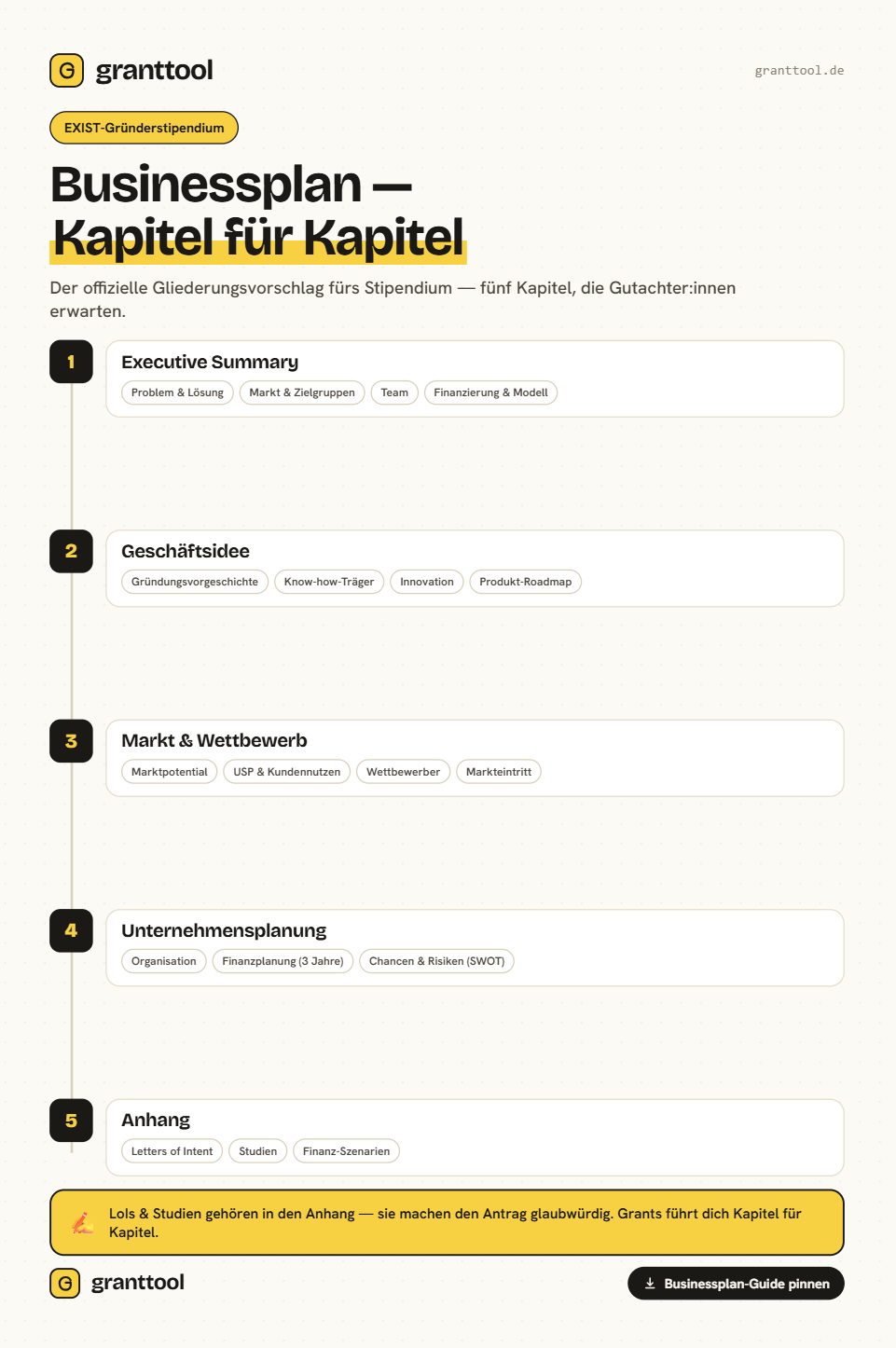
The Ideenpapier maps onto a five-chapter business-plan structure reviewers expect: executive summary, the business idea, market and competition, company planning, and the appendix. This infographic shows the chapter skeleton on one page so you can see the whole shape before you start filling sections in.
 Download
FAQ
Frequently asked
Try Grants
Free plan, no credit card. We host in Germany. You can export and delete everything self-serve.
Read next
How long an EXIST Gründerstipendium really takes (the honest 4-5 month timeline)
What every week of an EXIST application costs you - and what you can shorten.
Read
Why 44.7% of EXIST applications get rejected (and what makes the 55% that pass)
Read this before you submit, not after.
Read
Best tools for writing your EXIST application in 2026
What to use - and where each option breaks down.
Read
EXIST funding: the complete guide to the Gründerstipendium and Forschungstransfer
The central EXIST overview: variants, eligibility, amounts, the application path, and every step's deep-dive guide in one hub.
Read