
Topics
The team gap: how to name a missing role without sinking the team criterion
Every early team has a gap. The applications that score well name it and close it; the ones that score badly pretend it isn't there.

Reviewers do not expect a perfect team. They expect a team that knows what it is missing and has a plan for it.
The single most useful thing to internalise about the team sectionDoes every early team have a gap?
A complete founding team is supposed to cover three bases: someone who can build the product, someone who can sell it, and a third complementary role that fits the venture - regulatory for healthtech, design for a consumer app, hardware for a deeptech. Almost no pre-formation team actually covers all three with real depth. Two technical co-founders with no commercial counterpart is the classic shape; so is a strong commercial founder paired with a part-time technical advisor. Reviewers have read hundreds of these and they are not surprised by a gap. What they are watching for is whether you can see your own gap and have a credible plan to close it.
This is the move founders get wrong most often, and it is entirely about framing. Faced with a gap, the instinct is to stretch a founder's CV to cover it - the technical founder who suddenly has "strong commercial instincts," the solo founder who is "comfortable across the full stack of business functions." Reviewers see straight through this, and it costs you twice: once because the claimed competence is not credible, and again because the stretch signals a team that either cannot see its own weakness or hopes the reviewer won't. A named gap, by contrast, signals self-awareness - which is exactly the trait that predicts a team will adapt when reality hits.
The one-line gap statement that works
"Our team is strong on technology and product but does not yet have a dedicated commercial lead. We are closing this with [named advisor] now and a planned commercial hire in month six." One honest sentence plus a mechanism beats a paragraph of pretending.
What are the four credible ways to close a team gap?
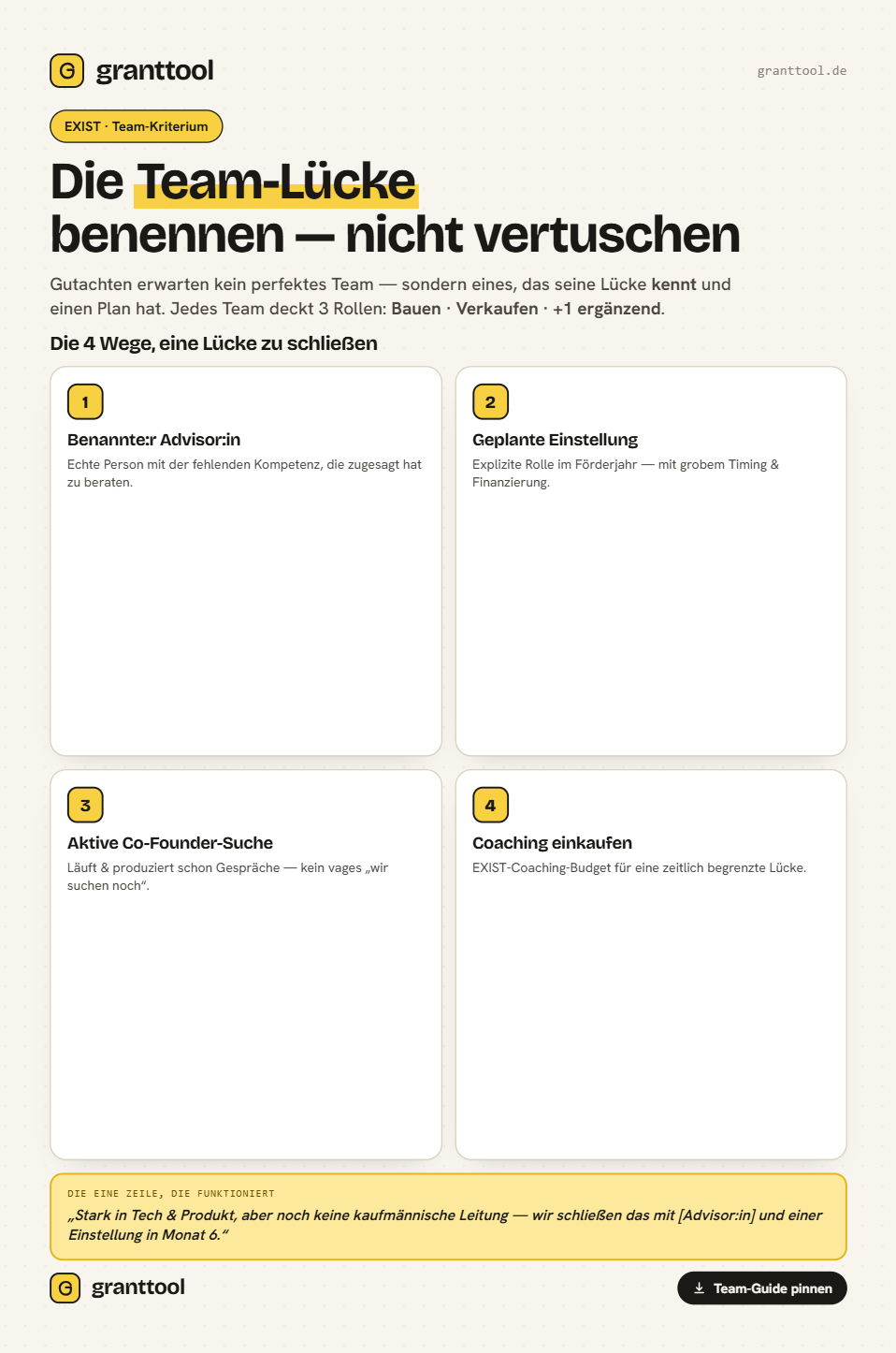
Naming the gap is half the move; the other half is showing how you close it. There are four credible mechanisms, and the strongest applications use the one that fits their situation rather than gesturing vaguely at all four.
Which gap-closing mechanism fits your situation? (at a glance)
Reviewers do not expect a perfect team — they expect a named gap with a credible plan to close it. The four mechanisms are a named advisor, a planned hire, an active co-founder search, or bought-in coaching. This infographic puts all four side by side so you can pick the one that actually fits your situation.
 Download
The advisor has to be real and reachable
If you name an advisor, they should know they are named and be willing to take a call. Panels occasionally verify, and a named advisor who turns out to have agreed to nothing is worse than no advisor at all. Get explicit agreement before you write the name.
How do you make each founder's role unmissable?
Beyond the gap, the team section is judged on clarity of roles. A reviewer reading fifty applications wants to know, in the first line of each founder's profile, what that person owns. "Technical lead - responsible for the ML pipeline and infrastructure" and "Commercial lead - responsible for go-to-market, pricing, and first customers" do that work. A profile that lists job titles and degrees without ever stating the role in the venture forces the reviewer to reconstruct the team structure, and a structure they have to reconstruct is one they may get wrong - or score as unclear. The same clarity matters in the Fachgespräch, where each founder is expected to speak credibly to their own section.
Role clarity also defuses the overlap problem. When two founders have similar backgrounds - two engineers, two MBAs - reviewers worry the team is redundant in one dimension and empty in another. Explicit, non-overlapping role lines answer that worry directly: yes, we are both technical by training, but one of us owns the product and customer-facing engineering and the other owns infrastructure and the research link. State the split, and the redundancy concern evaporates.
Can solo founders apply - and when is a gap a real problem?
Solo founders face the hardest version of this, because one person has to credibly cover technical, commercial, and the third role, and reviewers know that is a tall order for one human. Solo applications are allowed but structurally harder, and the way through is to lean hard on the closing mechanisms: a genuinely active co-founder search with evidence it is producing conversations, named advisors covering the roles you cannot, and an explicit statement of which roles you will hire into during the funded year. What a solo founder must not do is pretend the gaps are not there; a solo profile claiming full-spectrum competence is less credible, not more.
There is a line, though, between a gap you can name and close and a gap that is actually a feasibility problem. A team missing the one competence that is central to the venture's core risk - a deeptech with no one who understands the deep tech, a regulated-market venture with no path to the regulatory expertise - has a real problem, not a framing problem, and no amount of careful wording fixes it. If you find yourself unable to name a credible way to close the gap, that is a signal to fix the team before you apply, not to write around it. The reviewers will reach the same conclusion you are avoiding.
FAQ
Frequently asked
Try Grants
Free plan, no credit card. We host in Germany. You can export and delete everything self-serve.
Written by
Julia Yukovich
Co-Founder + CEO
Julia is one of the Co-Founders. She handles design, development, product direction, and most of the support replies that arrive in the morning.
Read next
The EXIST Lebenslauf: how to write the CV reviewers actually score
Role-anchored CV template with the four lines reviewers look for.
Read
What reviewers actually score: inside the EXIST Bewertungskriterien
The four criteria buckets and how to write to each.
Read
The Fachgespräch: how to pitch your EXIST idea to the PTJ and the Gutachten panel
Prep structure, the questions that always come, and how to handle the no-risk trap.
Read
EXIST funding: the complete guide to the Gründerstipendium and Forschungstransfer
The central EXIST overview: variants, eligibility, amounts, the application path, and every step's deep-dive guide in one hub.
Read