
Topics
What reviewers actually score: inside the EXIST Bewertungskriterien
Reviewers do not grade vibes. They grade against criteria. If you know the criteria, you can write directly to them.

Reviewers do not reward effort. They reward evidence mapped to the criteria.
What experienced Gründungsbüro coaches tell every teamThe mental model: a scorecard, not an essay grade
When a PTJ reviewer opens your application, they are not reading it the way a friend reads a draft. They are working through a set of evaluation criteria - the Bewertungskriterien - and forming a judgement against each one. The exact weighting and wording vary by programme and call, but for EXIST the substance clusters into four recurring buckets: the innovation, the team, the market and business model, and the feasibility of the plan. A great application is not the one that is most beautifully written; it is the one where each criterion has obvious, locatable evidence the reviewer can point to.
This reframes the whole writing task. Instead of "tell our story well," the job becomes "give the reviewer the evidence they need to score each criterion high, and make it impossible to miss." Headings, topic sentences, and figures all serve that goal.
The criteria are public for a reason
The programme guidelines and call texts spell out the evaluation dimensions. Reading them before you write is the single cheapest edge in the whole process, and it is free. Most rejected applications were never written against the actual criteria.
Criterion 1 - Innovation (the degree of novelty)
This is the single most heavily weighted bucket and the one most rejections cite. Reviewers are scoring genuine novelty against the state of the art, not novelty-to-you or novelty-to-the-German-market. To score this high you need a clear statement of what you do that nothing else does, plus citations - papers, competitor products, patents - that let the reviewer verify the gap exists. The fatal pattern is asserting the innovation without the references that make it checkable. If a reviewer cannot verify your novelty claim, they default to scoring it low, because their job is to fund verifiable innovation, not to take your word for it.
Criterion 2 - Team (can these people execute)
Reviewers score whether the team can actually deliver the plan. They look for role coverage (technical, commercial, the third complementary role), evidence each founder can fill their role, and the academic anchor that makes the application eligible at all. They also read the team section for risk: a single technical founder with no commercial counterpart is a scored weakness, not a neutral fact. Write to this criterion by making each founder's role and supporting evidence explicit, and by naming any gap together with how you close it. A named gap scores better than a pretended competence.
Worth knowing: EXIST has explicitly raised the weight of the team, naming it the central success factor for a start-up. So the team section is not the soft "about us" page some founders treat it as - it is one of the two heaviest-scored buckets alongside innovation. Invest accordingly: a strong team narrative tied to a credible idea outscores a brilliant idea attached to a thin team. Our EXIST-Lebenslauf guide covers the CV evidence each founder needs to make this score.
Criterion 3 - Market and business model
Here reviewers score whether there is a real market and a believable way to capture value from it. They want a sized market with citations, evidence you have left the building and talked to customers, and a business model that fits the programme (EXIST funds product/platform ventures, not consultancies). They are not expecting closed sales from a pre-formation team - they are expecting proof the team understands the market and has tested its assumptions. The strongest signal is three named customer conversations with what each said, which beats any amount of top-down TAM arithmetic.
Criterion 4 - Feasibility of the plan
The last bucket scores whether your twelve-month plan is realistic and whether the funding need is plausible. Reviewers look for a milestone plan they believe, named risks with mitigations (the no-risk pitch reads as naive, not confident), and a Finanzplan where every euro maps to something in the plan. A plan that promises a finished product, a patent, ten customers, and a seed round all in twelve months scores worse than a focused plan with three achievable milestones, because over-promising signals a team that has not thought hard about execution.
The cross-cutting criteria most founders miss
Beyond the four core buckets, EXIST asks applicants to address three ESF cross-cutting objectives that were added to the evaluation guidance: gender equality (Gleichstellung), non-discrimination (Nichtdiskriminierung), and sustainable development (Nachhaltigkeit). These are not a fifth bucket of equal weight - you will not win or lose on them alone - but they are part of the guidance reviewers work from, and a thoughtful half-page on them is cheap insurance against looking like you ignored the call.
Treat them honestly, not as a checkbox. Describe how equality and non-discrimination are anchored in how you plan to build the company - hiring, team culture, who the product serves - and where the venture aligns with federal sustainability goals, qualitatively and, where you can, quantitatively. A vague "we value diversity" line reads as filler; a concrete sentence ("our hiring plan targets a gender-balanced first five hires" or "the product cuts X by Y") reads as a team that actually thought about it. Forced or implausible claims hurt more than a short, genuine paragraph.
How to write to a scorecard
Once you accept that the reviewer is scoring against criteria, the editing technique falls out of it. Read your draft as a reviewer would: for each of the four buckets, can you find the evidence in under ten seconds. If the innovation criterion's evidence is buried in paragraph four of section two with no citation, the reviewer scoring quickly will miss it and mark you down. Move it to a topic sentence, add the citation, and signpost it. Do this for all four criteria and your application stops depending on a reviewer reading charitably - it scores well even on a fast, tired read.
Self-score before you submit
Before submission, score your own draft against the four buckets on a 1-5 scale and write one sentence of evidence for each. Any criterion you cannot evidence is a criterion the reviewer will mark down. Fix those first. Grants includes a KI self-scoring pass that does exactly this - it reads your draft against the criteria and flags the buckets where the evidence is thin, so you find the gaps before a reviewer does.
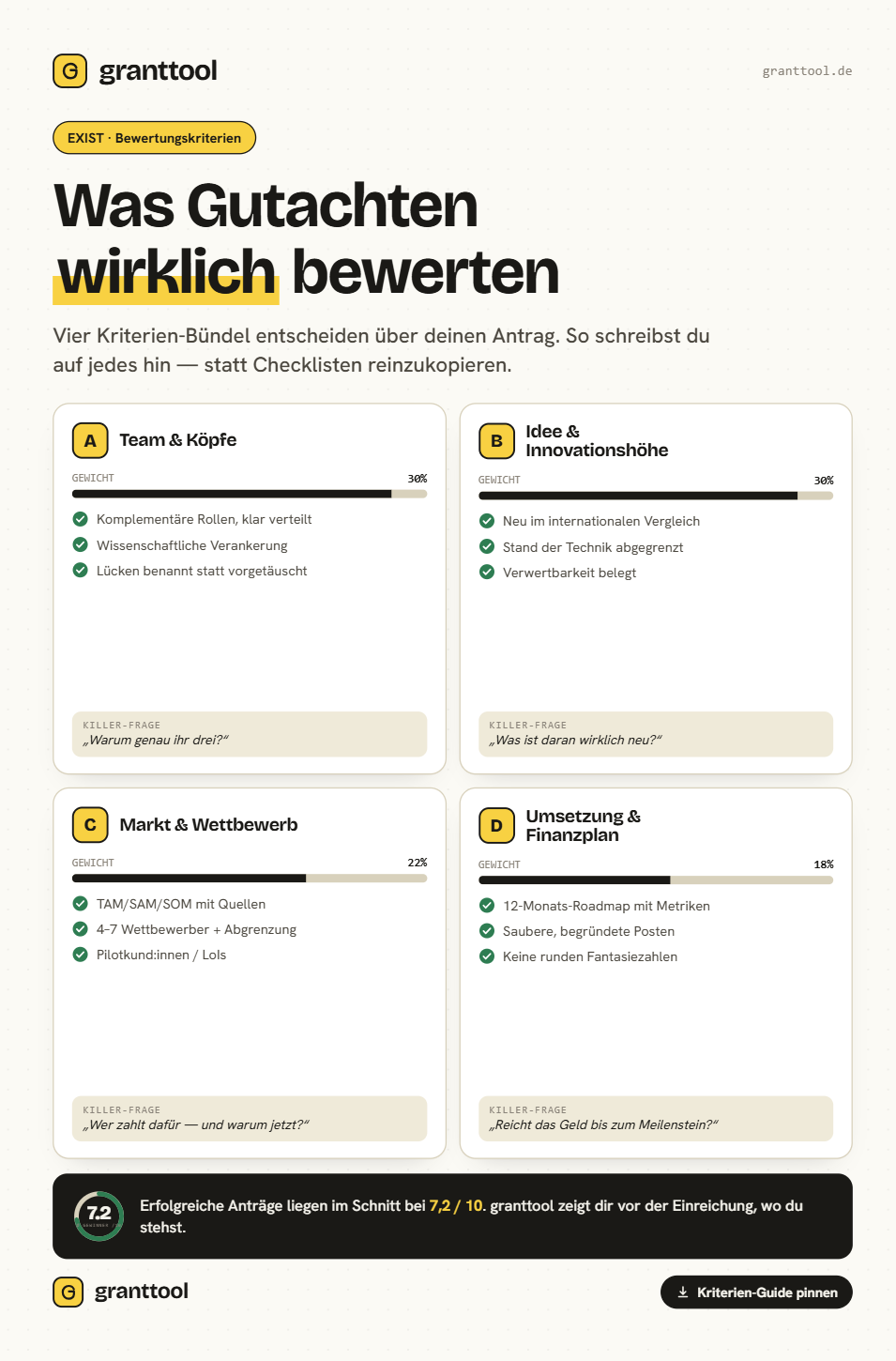
The four criteria buckets at a glance
Reviewers grade against criteria, not vibes. The four buckets are team, innovation, market and competition, and execution and financial plan — and each one needs locatable evidence. This infographic puts all four side by side with the points each scores, so you can self-score your draft before you submit.
 Download
FAQ
Frequently asked
Try Grants
Free plan, no credit card. We host in Germany. You can export and delete everything self-serve.
Read next
Behind the scenes: how Grants reviews your EXIST application
An inside look at our four review dimensions.
Read
EXIST Ideenpapier: structure, length, and the seven sections that decide your application
Section-by-section template with what reviewers expect.
Read
Why 44.7% of EXIST applications get rejected (and what makes the 55% that pass)
Read this before you submit, not after.
Read
EXIST funding: the complete guide to the Gründerstipendium and Forschungstransfer
The central EXIST overview: variants, eligibility, amounts, the application path, and every step's deep-dive guide in one hub.
Read