
Guides
Finding a name for your startup – 7 creative routes to the perfect name
A good name attracts people, sticks in memory, and carries your vision. Seven structured methods to find it.

Key takeaways
1. What makes you special?
Before brainstorming, clarify: which problem do you solve? Which target audience do you address? What emotion should the name trigger? Write down 5–10 keywords that describe your project. Looking at competitors helps too – what words come to mind for them, and how do you want to be different?
2. Use AI and name generators
Tools like namelix.com, ChatGPT, and looka.com/business-name-generator generate name ideas from your keywords. Combine: input keywords, a style (modern, elegant, techy), and optionally generate a logo at the same time. Beware of complexity – a single letter logo works perfectly too, as our logo guide shows.
3. Wordplay and analogies
Sometimes a clever double meaning or inspiring metaphor does the job: visual metaphors ('compass', 'rocket', 'bridge'), word blends (Spotify = Spot + Identify), Latin or Greek roots, or insider terms from your industry. Browsing Reddit for language your target audience actually uses is a surprisingly effective inspiration source.
4. The .com test
Is the domain still available? Check namecheckr.com, GoDaddy, or Ionos. Social media handles should also be free – LinkedIn, Instagram, Facebook, TikTok, and X. Check everything at once with a tool like namecheckr.com before falling in love with a name that's already taken everywhere.
5. Pronounceability and spelling test
Can the name be spelled and pronounced intuitively? Have friends and outsiders guess – you'll quickly see whether it sticks or leads to misunderstandings. Be careful if your team thinks in English but your audience doesn't (or vice versa) – the same name can be read very differently across languages.
6. Legal protection
Search for similar names in TMView (tmdn.org) and check the DPMA register for identical entries. Look in the WIPO Global Brand Database to see which classes competitors in your sector have registered. The EU trademark classification assistant TMclass (europa.eu) helps identify the right classes for your brand. Trademark registration is worth getting legal advice for — see also how to protect IP in grant applications.
7. The pitch test
Imagine pitching in front of a jury: does the name come across clearly? Does it fit your vision? A good test: how does it look in a logo, on a business card, in the app store? If you can picture it on stage and it still feels right – you may have found your name.
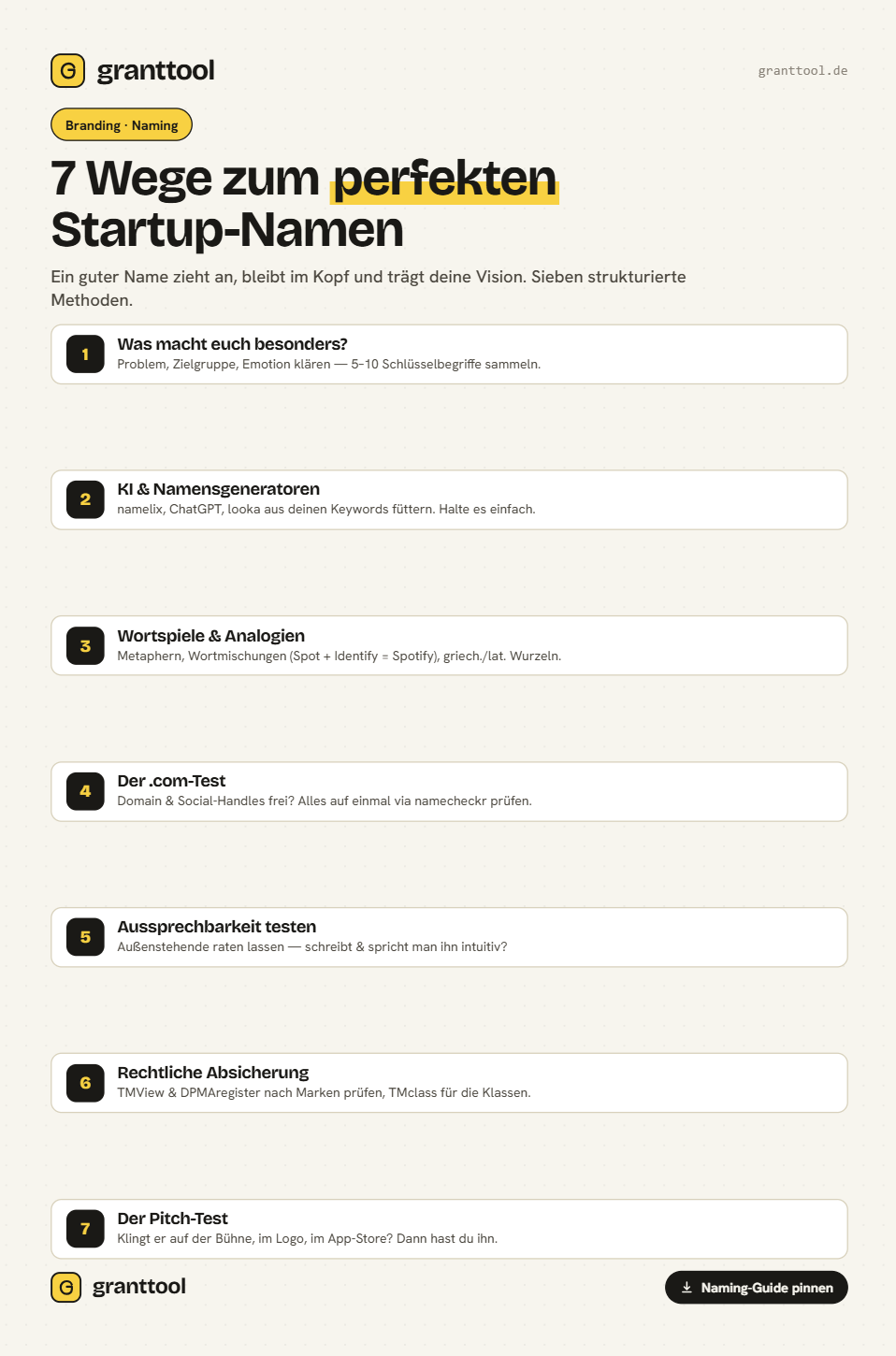
The seven routes to a name at a glance
From clarifying what makes you unique through AI generators, wordplay, the .com test, pronounceability, legal protection, and the pitch test — the whole naming process on one page. Run every candidate through all seven before you commit and invest in brand-building.
 Download
FAQ
Frequently asked
Try Grants
Free plan, no credit card. We host in Germany. You can export and delete everything self-serve.
Written by
Julia Yukovich
Co-Founder + CEO
Julia is one of the Co-Founders. She handles design, development, product direction, and most of the support replies that arrive in the morning.
Read next
EXIST logo in 2 minutes – free and without design skills
Two steps, no design skills required.
Read
5 common mistakes in the EXIST application – and how to avoid them
A practical checklist before you submit.
Read
EXIST Ideenpapier: structure, length, and the seven sections that decide your application
Section-by-section template with what reviewers expect.
Read