
Guides
What financing options are there for startups? The post-EXIST financing map (INVEST, Mikromezzanin, seed VC)
Loan, keep equity, give up equity, or grants - which financing type fits? And how to plan the follow-on round from month one after the stipend.

Key takeaways
Decide VC-shaped or not, honestly
Assess whether your venture has the market size and growth path a VC needs, or whether it is a strong business better served by non-dilutive capital. This choice shapes everything downstream.
Size the next-milestone capital need
Calculate how much you need to reach the next meaningful proof point. A small bridge points to Mikromezzanin or a loan; a large jump points to angels or seed VC.
Map the instruments to that need
Match your situation to the right layer: angels + INVEST or seed VC for equity, Mikromezzanin or a KfW/development-bank loan for non-dilutive, a later project grant for R&D-heavy roadmaps.
Start the relationships in month one, not month ten
Build a simple data room, keep a warm-contact list, and begin investor and programme conversations early - fundraising takes months and the grant year is shorter than it feels.
Why you plan the next round during the grant, not after
The single biggest mistake founders make with an early grant is treating it as the whole plan. The EXIST Gründerstipendium funds roughly a year; the funded year ends whether or not you have a path to keep going. Ventures that continue smoothly are the ones that started building the next financing step in the first months, while they still had runway and momentum to do it. Ventures that stall are the ones that hit month ten, look up, and realise they have eight weeks of runway and no investor conversations started. Fundraising takes months, so the time to begin is long before the grant runs out.
This is also why reviewers and the Fachgespräch panel ask "what happens after the funded year." They are not funding an endpoint; they are funding a runway to a next step, and they want that next step to be credible. So planning the follow-on is not only good for your venture, it strengthens the original application - a team that can articulate the financing path beyond the grant reads as one that understands the journey it is on.
The equity path: angels, INVEST, and seed VC
The most common path after an early grant is the first equity round - selling a slice of the company for capital. At the earliest stage this usually means business angels: individuals who invest their own money and often bring operational help. This is where INVEST comes in, and it is widely misunderstood. INVEST (the Zuschuss für Wagniskapital) is a federal subsidy that reimburses a private investor a share of what they invest in a qualifying young innovative company. It is designed to make angel investment into startups like yours more attractive to the angel - so it is not money you apply to spend, it is a sweetener that helps you close angels. Knowing INVEST exists and being a qualifying company for it is a real card to play when talking to angels.
Above the angel stage sits seed venture capital - institutional funds that write larger first cheques. Seed VC expects more than a grant did: traction or a very strong team-and-thesis, a clear market, and a path to the kind of growth that returns a fund. Not every venture is a VC venture, and that is fine - a profitable, steadily growing company is a great outcome that simply is not VC-shaped. Be honest early about whether you are building a VC-fundable company or a bootstrappable one, because the answer changes which follow-on path you should be cultivating from month one. None of this is investment or tax advice; the structuring of any round has real legal and tax consequences you should take to professionals.
The non-dilutive path: Mikromezzanin, loans, and further grants
Not every follow-on has to cost equity. There is a whole non-dilutive layer that founders often overlook because angels and VC get all the attention. Mikromezzanin (the Mikromezzaninfonds) provides small amounts of mezzanine capital to young and small companies - it behaves more like patient debt than equity and does not take a board seat or large ownership, which makes it useful for a venture that needs a modest amount of capital but is not ready or willing to sell equity. Public development banks and the KfW also run startup loan programmes that can bridge a venture to revenue or to a proper equity round without dilution.
And the grant journey often continues. A venture that took an early stipend can frequently apply for a later, larger project grant once it has an R&D-heavy roadmap and (for some programmes) an operating company - ZIM, IGP, regional project lines, and the EU programmes are all designed for stages past the first stipend. The strongest funding journeys mix all three layers over time: a stipend for the personal runway, a non-dilutive line or an angel round at formation, and a project grant or larger round once the company has substance. Plan the sequence deliberately and mind the double-funding and cumulation rules between any programmes that overlap in time.
Choosing your path: what your venture actually needs
The right follow-on is the one that fits your venture's shape, not the one with the most prestige. Ask three questions. First, how much capital do you actually need to reach the next meaningful milestone - a small bridge points you at Mikromezzanin or a loan, a large jump points you at angels or VC. Second, is the venture VC-shaped - a huge market and a path to fund-returning growth - or is it a strong but more modest business better served by non-dilutive capital and revenue. Third, how much dilution and outside control are you willing to take on now versus later - selling equity cheaply at the earliest, riskiest stage is expensive, so deferring an equity round with non-dilutive bridges can be the smarter sequence.
Whatever path fits, start cultivating it early and in parallel with the grant work. Build a simple data room as you go, keep a running list of warm investor and programme contacts, and treat the funded year's milestones as the proof points your next funder will want to see. The team that hits the end of the grant with a working product, named customer conversations, and three investor relationships already started is in a completely different position than the team with a great year of building and no next step lined up. And because every instrument here carries legal, tax, and equity consequences, take the actual decisions to qualified advisors - this article is a map, not advice.
The financing map at a glance
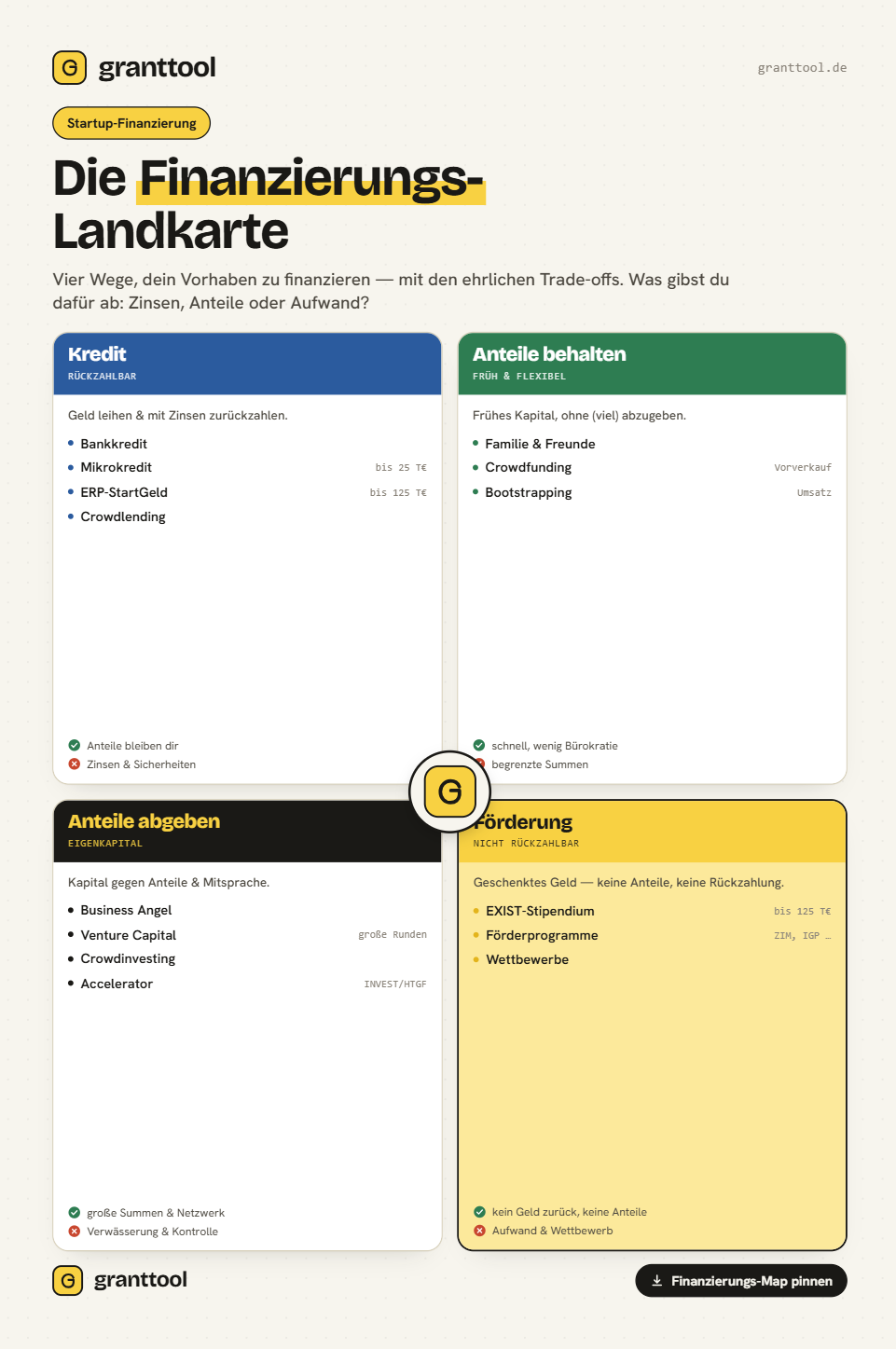
Four ways to finance a venture, each with its own trade-off on interest, ownership, and effort: a loan, keeping your equity (family/crowdfunding), giving up equity (VC/accelerator), and grant funding. This infographic puts the whole landscape side by side so you can see at a glance which route fits your stage and your appetite for dilution.
 Download
FAQ
Frequently asked
Draft the next application in Grants
The follow-on programme still needs a written application against its own criteria. Grants gives you the section structure, deadline tracking, and the revision window - hosted in Germany.
Read next
Regional vs federal: when a Bayern, NRW, or Berlin programme beats a Bundesprogramm
How the two layers differ, where each wins, and how to sequence them without double funding.
Read
Which funding is there for startups? All German programmes by stage (2026)
Which funding is there for startups in 2026? Idea, prototype, formation, and R&D-scale grants mapped to your stage.
Read
ZIM - Zentrales Innovationsprogramm Mittelstand: Germany's flagship rolling R&D funding for SMEs
Project types, eligibility, the technical-novelty bar, and the 2025 Projektträger split (AiF / VDI/VDE).
Read
EXIST funding: the complete guide to the Gründerstipendium and Forschungstransfer
The central EXIST overview: variants, eligibility, amounts, the application path, and every step's deep-dive guide in one hub.
Read