
Best of
Which funding is there for startups? All German programmes by stage (2026)
There is no single best grant - there is the right programme for where your venture is right now. The complete stage-by-stage map of German startup funding for 2026.

Short answer: there is no single best startup grant. Pre-formation and university-linked? EXIST Gründerstipendium. Coming out of unemployment? Gründungszuschuss. A young company with non-technical, market-novel innovation? IGP. Doing genuine R&D? the Forschungszulage tax credit (combinable, retroactive, any size). Raising from an angel? INVEST. An established SME with an R&D project? ZIM. Match the programme to your stage first - the rest of this page expands each one.
The most common funding mistake we see is not a weak application - it is a strong application to the wrong programme for the venture's stage. Each German grant is designed for a particular moment in a startup's life, and applying to a stage-mismatched programme means competing for a slot you were structurally never going to win. This list maps the major programmes to the stage they actually serve, so you start with fit before you start writing.
Programme details, sums, and eligibility windows change. Treat this as a routing map, then confirm the current call text for whichever programme fits.
The picks
Tools we'd recommend for founders choosing a programme by stage looking at German startup funding programmes.
Grants
Write the application itself, structured to the criteria
Grants is not a funding programme - it is the workspace where you write the application for whichever programme fits your stage. It ships the section structure reviewers expect for EXIST, IGP, and the regional lines, tracks deadlines and the post-rejection revision window, and is hosted in Germany. Once you have used this list to pick the right programme, this is where you draft the Ideenpapier, Finanzplan, and Verwertungsplan against the actual Bewertungskriterien.
Strengths
Trade-offs
Best for
Founders who have picked their programme and now have to write a strong application.
EXIST Gründerstipendium
Pre-formation, university-linked, technology-based ventures
The flagship federal programme for founders coming out of a university with a science- or technology-based idea. Pays the founders a living stipend plus Sachausgaben and Coaching for a defined period so you can build full-time before forming a company. Structurally a Hochschul-Antrag with a required academic mentor.
Strengths
Trade-offs
Best for
Pre-formation teams out of a research group or thesis with a technical innovation.
Gründungszuschuss
Personal runway for founders coming out of unemployment
Not an innovation grant at all - the Gründungszuschuss is paid by the Agentur für Arbeit to people who start a business out of unemployment while still entitled to ALG I. It covers your living costs for the first months (your benefit rate plus a flat monthly top-up), with an optional second phase. The gate is your employment situation, not the novelty of your idea, which makes it the one early-stage option open to non-technical, non-university founders who happen to be eligible.
Strengths
Trade-offs
Best for
Solo or small founders eligible for ALG I who need personal runway, not project money.
IGP
Market-novel, non-technical innovation for young companies
The Innovationsprogramm für Geschäftsmodelle und Pionierlösungen funds the innovations that fall outside classic R&D: business model innovations, service innovations, design-led products. It funds companies rather than paying individuals a stipend, making it the natural home for ventures that get awkwardly rejected from technology-first programmes.
Strengths
Trade-offs
Best for
Young companies whose novelty is in the model, service, or design - not a technical breakthrough.
BW Pre-Seed
Regional early-company financing for Baden-Württemberg
A regional Baden-Württemberg programme that bridges young companies past the pre-formation stage toward a first institutional round, often combining a grant-like component with an investment. A strong follow-on for a BW-based team that has used EXIST for the personal runway and now needs company-level financing.
Strengths
Trade-offs
Best for
Newly formed BW companies needing financing past the pre-formation stage.
INVEST - Zuschuss für Wagniskapital
Makes your seed round more attractive to business angels
INVEST does not pay the startup directly - it refunds a quarter of a business angel's investment back to the angel, which makes a ticket into your company materially more attractive. There is also an exit-grant component on capital gains. To qualify, the startup is generally young (under seven years), small (under fifty employees), and innovative. It is the right lever once you are raising a seed round and want to lower the angel's effective risk rather than apply for project money.
Strengths
Trade-offs
Best for
Young, small, innovative companies raising an angel round who want to sweeten the ticket.
ZIM
R&D project funding for established SMEs
The Zentrales Innovationsprogramm Mittelstand funds genuine research-and-development projects in small and medium enterprises, including cooperation projects with research partners. It is the right line once you are a real company with an R&D-heavy project to fund - a later stage than EXIST, with a focus on the technical work itself rather than founder living costs.
Strengths
Trade-offs
Best for
Established SMEs with a concrete, technically risky R&D project to fund.
Forschungszulage
The R&D tax credit that cuts across every stage
The Forschungszulage (research allowance) is the odd one out on this list because it is not stage-gated and not a competitive call - it is a legal entitlement under the Forschungszulagengesetz for any company doing qualifying research and development, from a two-person startup to an established firm. It refunds a share of your eligible R&D costs (a larger share for small companies since the 2024 reform), is claimed via the tax system rather than a grant jury, and can be applied for retroactively for work already done. Crucially, it is designed to be combinable with other funding, as long as you do not claim the same euro of cost twice.
Strengths
Trade-offs
Best for
Any company with real R&D spend that wants a combinable, non-competitive top-up.
How to use this map
Locate your venture's current stage first - idea and pre-formation, early company, formation-to-first-round, or established SME with an R&D project. Then read only the programmes that serve that stage. Applying up or down the stage ladder almost always wastes a strong application. When two programmes seem to fit, the tiebreaker is usually the funding shape: do you need a personal stipend, company project funding, or financing toward a round.
Most successful founder journeys use more than one programme in sequence: a stipend for the personal runway, a regional or company-level line at formation, then a project grant once there is an R&D-heavy roadmap. Plan the sequence early, mind the double-funding rules between overlapping programmes, and write each application against the specific programme's own Bewertungskriterien.
Combining programmes - and the rules that limit it
The real leverage in German funding is sequencing and combining lines, not winning one big grant. Many programmes are designed to stack: an EXIST stipend for personal runway, then a regional formation line, then the Forschungszulage running underneath your R&D the whole way. But there are two hard limits. First, you cannot fund the same euro of cost from two sources - claiming a developer's salary from a project grant and the Forschungszulage for the same hours is double-funding, and it is not allowed. Second, several programmes count toward de-minimis state-aid ceilings, so a stack that looks fine individually can hit an aggregate cap.
The practical rule: design the stack so each programme funds a different cost or a different period, keep a clean record of which euro came from where, and check the de-minimis position before you add a line. Our de-minimis and double-funding guide walks the ceilings in detail. This is administrative hygiene, not legal advice - your Bewilligungsbescheid and the programme's own rules are binding, and we are not your legal or tax advisor.
Common questions about choosing a programme
Which funding is there for a startup with no university link? IGP for non-technical, market-novel innovation; the Gründungszuschuss if you are eligible from unemployment; the Forschungszulage if you do genuine R&D; and regional Länder programmes. EXIST and EXIST-Forschungstransfer are the ones that need the academic anchor - everything else on this page does not.
Is there one grant that just pays our salaries? The closest is a living-cost stipend like EXIST or the Gründungszuschuss, and both are early-stage and capped to modest personal runway, not team salaries. Project grants (ZIM) and the Forschungszulage fund work and R&D cost, not founder lifestyle. There is no German programme that simply pays a growing team's payroll - that is what revenue and a financing round are for.
Which programme is fastest? The Forschungszulage and the Gründungszuschuss decide on entitlement rather than a competitive jury, so they tend to be more predictable than the big calls. EXIST, IGP, and ZIM run on call rhythms and expert panels, which means months from outline to decision. If timing is tight, read each programme's funding criteria and deadline rhythm before you commit, and do not assume a grant arrives in time to cover a cash gap you already have.
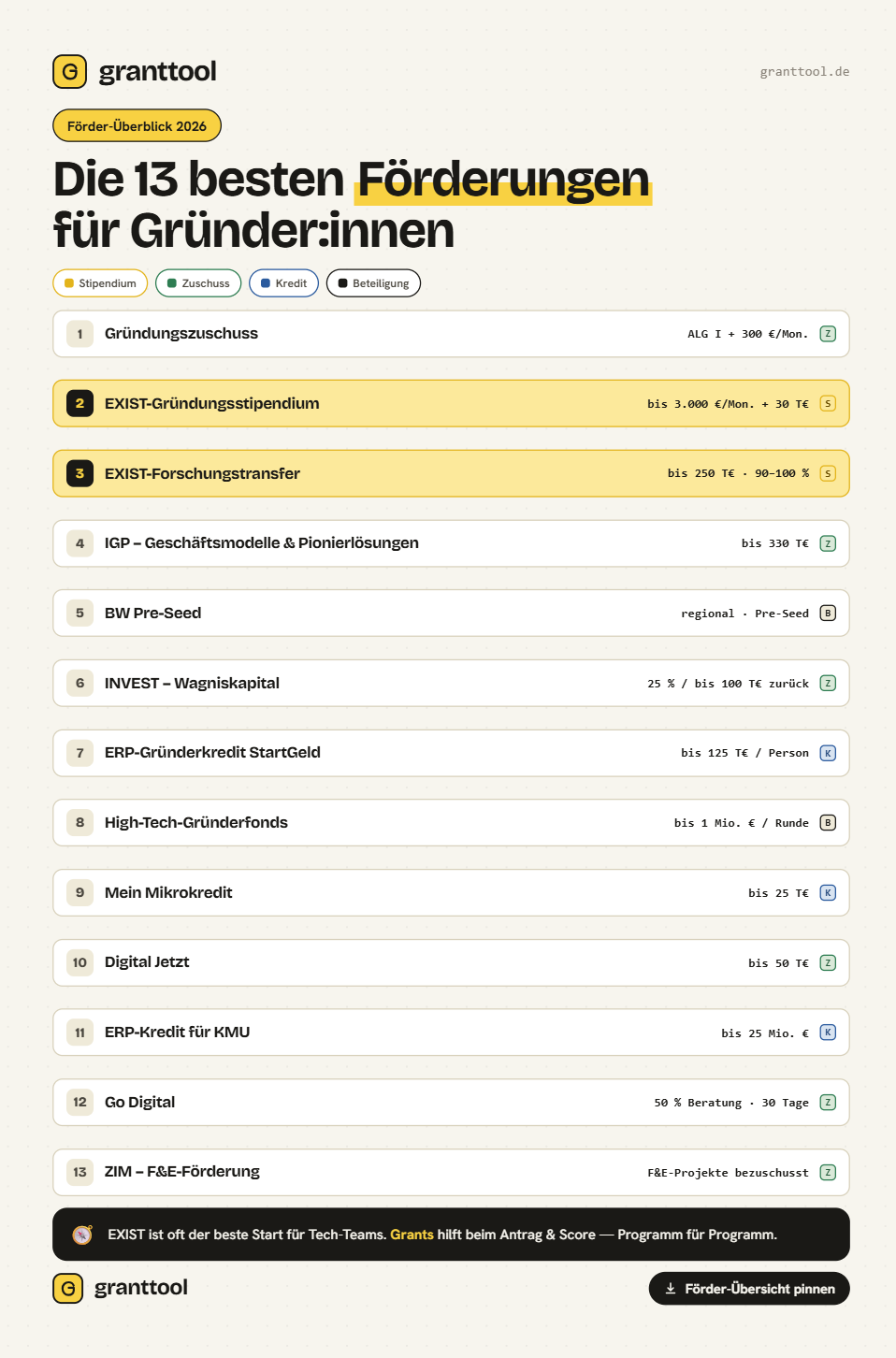
The 13 most relevant German grants at a glance
From Gründungszuschuss through EXIST, IGP, BW Pre-Seed, INVEST, High-Tech-Gründerfonds, Mikromezzanin, Digital Jetzt, ZIM and more — this overview ranks the thirteen programmes founders ask about most, with the typical sum each one pays. Use it as a shortlist, then read the stage-specific entry for whichever fits your phase.
 Download
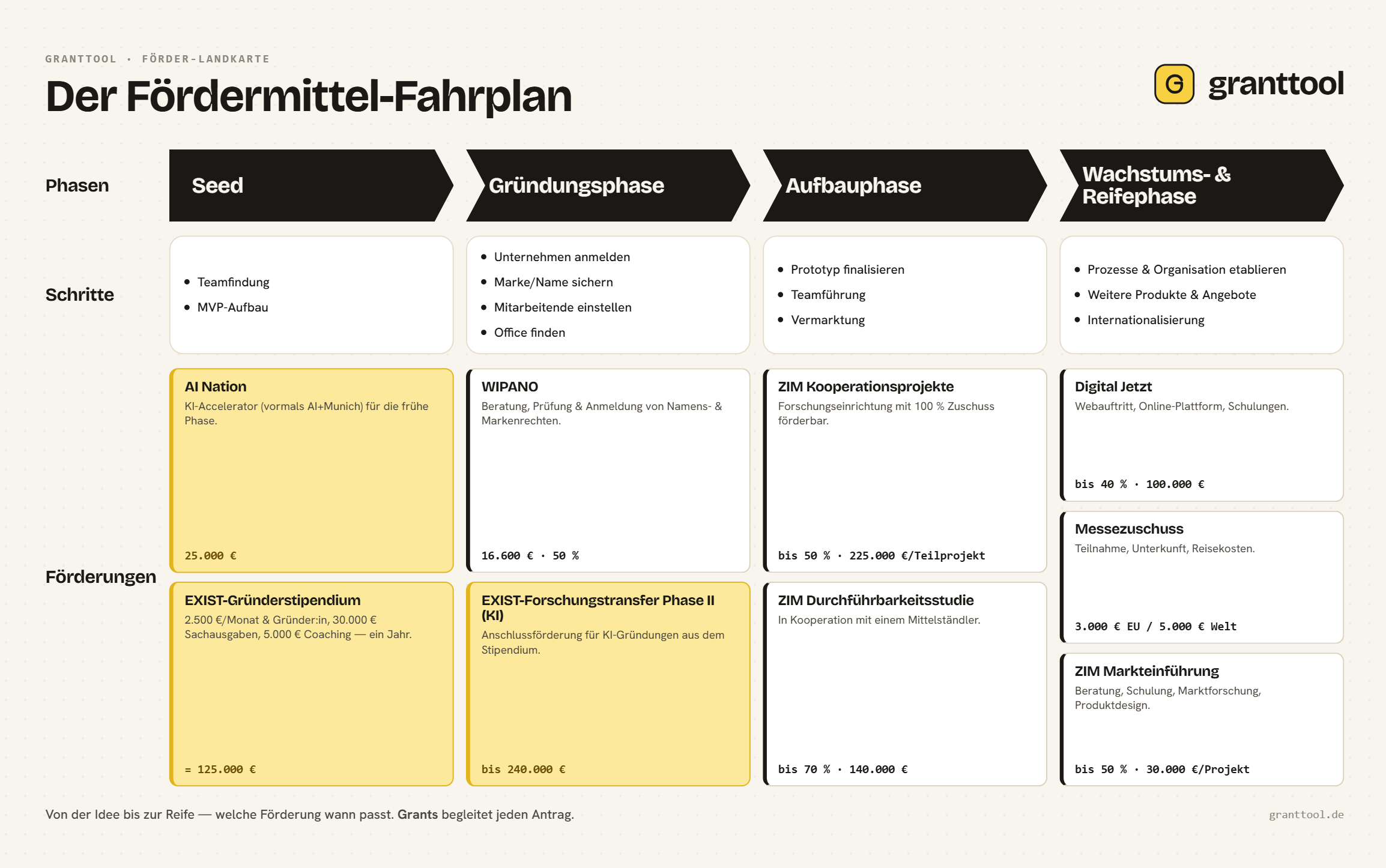
The funding roadmap from seed to growth
Every German programme is built for a particular moment in a venture's life. This roadmap lays the major lines out across four phases — seed, formation, build-up, growth — with the steps and the typical sum for each, so you can see at a glance which programme serves the phase you are in right now.
 Download
Try Grants
Free plan, no credit card. We host in Germany. You can export and delete everything self-serve.
Read next
IGP or EXIST? How to choose the right early-stage grant for your venture
Eligibility, what each funds, and the decision tree.
Read
Best tools for writing your EXIST application in 2026
What to use - and where each option breaks down.
Read
Start-up BW Pre-Seed: how Baden-Württemberg co-invests with your business angel
Why a co-investor matters, what counts as Baden-Württemberg ties, and the real timeline.
Read