
Guides
IGP - Innovationsprogramm: BMWK funding for new business models
Non-dilutive BMWE funding for non-technical innovation - business models, services, platforms, pioneer solutions. Two project types, a jury pitch, and one end goal the program measures you on: more revenue and more jobs.
Key takeaways
Check fit and pick the project type
Confirm your idea is non-technical innovation (business model, service, platform) and you are an SME based in Germany. Choose feasibility (≤12 months) or market-readiness (≤24 months) - you can't switch later.
Line up a Verbund partner
Recent calls fund only consortia of at least two companies. Find a partner who covers at least 20% of the work and isn't economically linked to you; a research institution can join (capped at 50%).
Submit the project sketch via positron:s
Prepare the Projektskizze including the IGP poster and business sheet, and submit through the positron:s platform before the call's Stichtag. The sketch can't be edited after submission.
Pitch to the jury, then file the Vollantrag
Shortlisted teams pitch to a jury. If convinced, you file the full application (Vollantrag) via easy-Online. Plan roughly six months from sketch to Bewilligungsbescheid; the decision rests with the jury.
Run the project and report
After approval, draw funds quarterly and retroactively against proof of costs via profi-Online, keep daily hour logs, and file the Verwendungsnachweis within three months of project end. VDI/VDE-IT is your point of contact.
What counts as a 'business model innovation'
IGP funds the conception and pilot of new ways to deliver value - subscription models for previously-sold products, marketplace structures, platform business, new pricing logics, integration of underrepresented user groups, sustainability-driven business redesigns. The innovation does not need to be technically novel; it needs to be a genuine market or operational novelty in your segment.
Feasibility vs market-readiness project
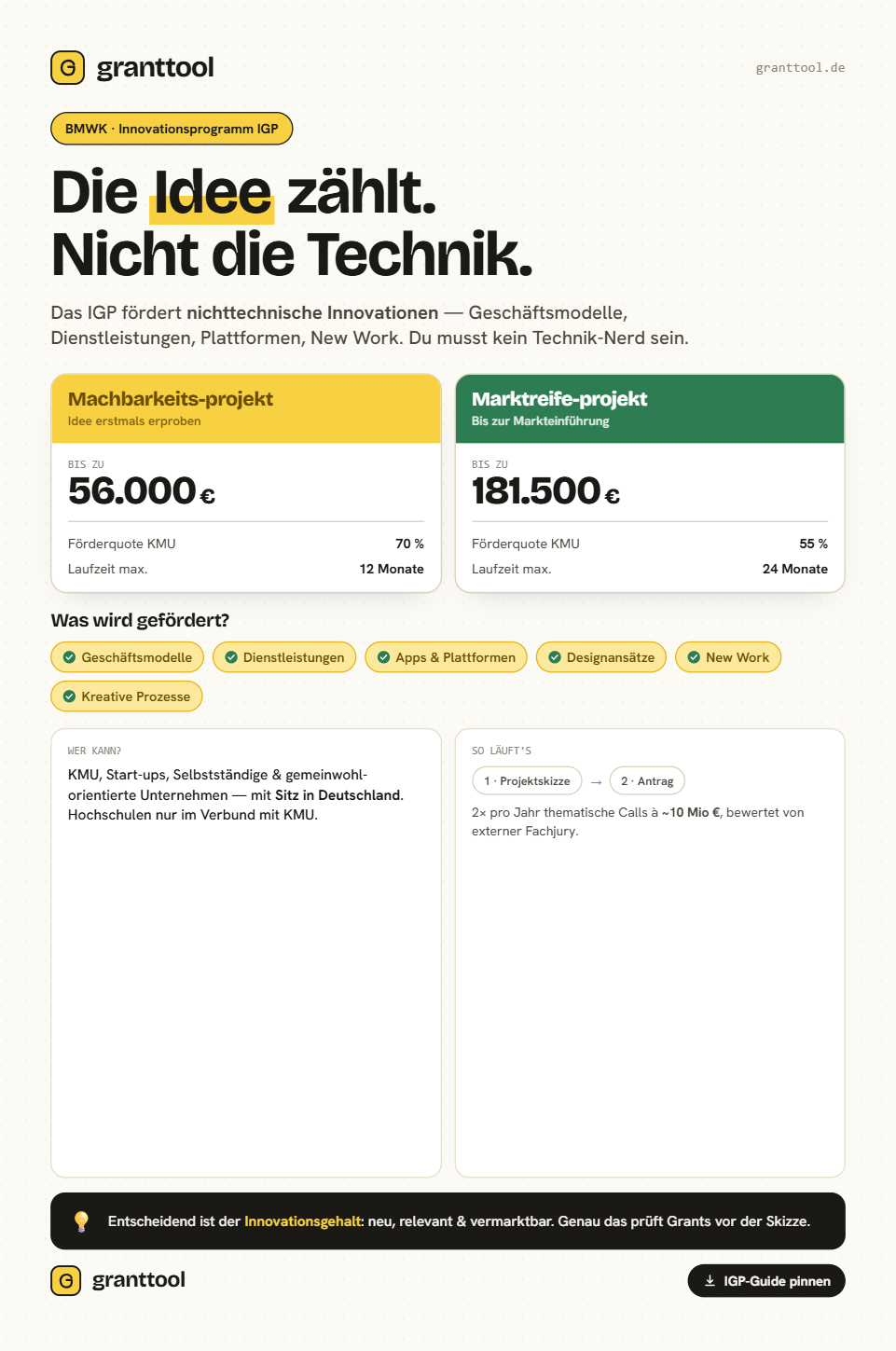
IGP funds the idea, not the technology — business models, services, apps and platforms, design processes, new work, pioneer solutions. Two project types sit side by side. A feasibility project runs up to 12 months, with up to €80k eligible costs at a higher rate (up to 70% for a micro-business) — it answers 'is this viable?'. A market-readiness project runs up to 24 months, with up to €330k eligible costs at a lower rate (up to 55%) — it takes a validated idea to market. Within those, personnel costs are capped at €100k per person/year, sub-contracts at 40% of personnel costs, and overheads run at 50% (75% in exceptions) of personnel costs.
 Download
Who can apply
SMEs (KMU per EU definition: <250 employees, <€50M turnover or <€43M balance sheet total) based in Germany. Startups under 5 years old qualify. Your company size sets your funding rate — micro-businesses get the highest, then small and medium; non-profit SMEs reach up to 75% and research institutions up to 100%, which makes them strong partners on a project.
What you submit
Two stages. First a project sketch (Projektskizze) — including the IGP poster and a business sheet — submitted through the positron:s platform. Shortlisted teams then pitch to a jury; if convinced, you submit the full application (Vollantrag). Across both, cover: starting situation and market, the innovation concept (what's new and why now), an implementation plan with milestones, market and competition analysis, exploitation plan, risk analysis, and a detailed budget. The Projektträger is VDI/VDE — your point of contact for questions and, later, the Zwischenberichte, Abschlussbericht and Verwendungsnachweise.
Timeline
Stichtage are usually once or twice a year per call. From submission to Bewilligungsbescheid: ~6 months. Decisions arrive in writing with reviewer feedback. Funding period typically starts 1-3 months after the decision; reimbursement is on incurred costs against quarterly Mittelabrufe.
What an IGP project actually gets you
The obvious part is the money — a non-dilutive grant that covers the bulk of eligible costs, so you fund the work without giving up equity. But the bigger return is validated proof on three axes: proof of concept (is the idea feasible at all?), proof of feasibility (does it stack up economically and organisationally?), and proof of value (does the target group actually want it?). Even the jury pitch earns its keep — building it forces you to sharpen the idea, and the jury's questions surface the open risks and the next concrete steps.
Downstream, funded teams typically report the effects the program cares about: revenue growth, new hires, new domestic and international markets, new target groups, plus more visibility and reputation. IGP is designed to make those happen — not to subsidise a nice prototype that goes nowhere.
The end goal reviewers reward: more revenue, more jobs
Here's what founders underweight: IGP is ultimately measured on economic impact — does the funded company grow its revenue and its headcount? That, alongside competitiveness and new markets, is the program's real success metric. Reviewers select for innovation degree, digital value-add, market potential and a credible team — but all of it is in service of that economic outcome.
So say it out loud in your application. Name the end goal — the revenue and employee trajectory you're aiming for — and then draw the line to it: which milestones turn the funded work into paying customers, and how that revenue converts into hires. A proposal that connects 'funded innovation → more revenue → more jobs' with concrete numbers beats a clever concept that leaves the economic outcome implicit. Your exploitation plan is exactly where that line belongs.
Funding rates by company size
Your funding rate steps down with company size, and differs between the two project types. For a feasibility project the ladder runs roughly: non-profit SMEs 75%, micro-businesses 70%, small 65%, medium 60%. For a market-readiness project it is lower across the board: non-profit 60%, micro 55%, small 50%, medium 45%. Universities and research institutions are funded up to 100% but capped at €180k, which is why they make strong project partners rather than lead applicants. Rates and caps are set per call - confirm them against the open Bekanntmachung.
Verbund projects and cooperation rules
Recent calls have shifted IGP toward Verbundprojekte: the open call funds only consortia of at least two participating companies, so plan for a partner rather than a solo application (verify on the live Bekanntmachung). The economics scale with the Verbund: a feasibility consortium can reach up to ~€150k in total, a market-readiness consortium up to ~€600k, on top of the per-partner caps (€80k / €330k). The rules keep it a genuine collaboration: each partner must carry at least 20% of the work (in person-months), a Verbund has at most five partners, research entities are capped at 50% of costs and work, and economically linked firms count as one unit - so two of your own companies can't form the required pair. Foreign companies may cooperate but receive no funding (only as sub-contractors).
Which costs are eligible
IGP reimburses incurred costs, not a lump sum. Personnel costs (gross wages) are the core, capped at €100k per person per year. Sub-contracts (Aufträge an Dritte) are limited to 40% of personnel costs, and 'sonstige' costs (overheads, materials, etc.) run at 50% - up to 75% in exceptions - of personnel costs for companies. Watch the Besserstellungsverbot: if more than 50% of your budget is public funding, salaries can't exceed the TVöD-Bund scale. Preliminary work done before approval is at your own risk and is not reimbursed retroactively.
What happens after the grant decision
Winning is the start of the admin, not the end. Disbursement is quarterly and retroactive - you spend first, then claim against proof of costs through the profi-Online portal. You keep daily hour logs (signed monthly), provide receipts for sub-contracts over a low threshold, and file the final Verwendungsnachweis within three months of the project end; on-site checks are possible. One constraint pair worth knowing up front: the project sketch can't be revised after submission, and you can't switch project type mid-competition - so get the type and scope right before you submit.
FAQ
Frequently asked
Try Grants
Free plan, no credit card. We host in Germany. You can export and delete everything self-serve.
Read next
KMU innovativ: BMBF fast-track R&D funding for innovative SMEs
Tech-domains, Skizze structure, and what 'fast track' really means.
Read
EXIST Gründerstipendium: everything you need before you apply
Eligibility, amounts, what to submit, and the real timeline.
Read
De-minimis: the €300k cap that decides which grants you can actually stack
How to count, which programmes use it, and the planning trap.
Read
ZIM - Zentrales Innovationsprogramm Mittelstand: Germany's flagship rolling R&D funding for SMEs
Project types, eligibility, the technical-novelty bar, and the 2025 Projektträger split (AiF / VDI/VDE).
Read