
Guides
Marketing & sales costs for the EXIST application: how to calculate CAC and CLV
How to project your annual marketing and sales spend per channel – with formulas, benchmarks, and a worked example.

Key takeaways
1. Forecast your sales volume
Before you calculate costs you need to estimate the expected sales closings per year. Scale up historical data if available, draw on market research studies, or model scenarios. Build at least three scenarios – conservative, realistic, optimistic. For the EXIST application you can present one scenario while noting the range.

2. Customer acquisition channels
The most common acquisition channels for early-stage startups are: referral & repeat purchases (often zero additional CAC), events and trade shows (direct contact, live demos, networking), digital advertising (LinkedIn, Google Ads, SEO, programmatic), and cold outreach / mailings (email campaigns, inside sales, direct mail). For B2B, trade shows, LinkedIn, and referral programmes are often more effective than pure social media campaigns.
3. Calculating annual costs and CLV
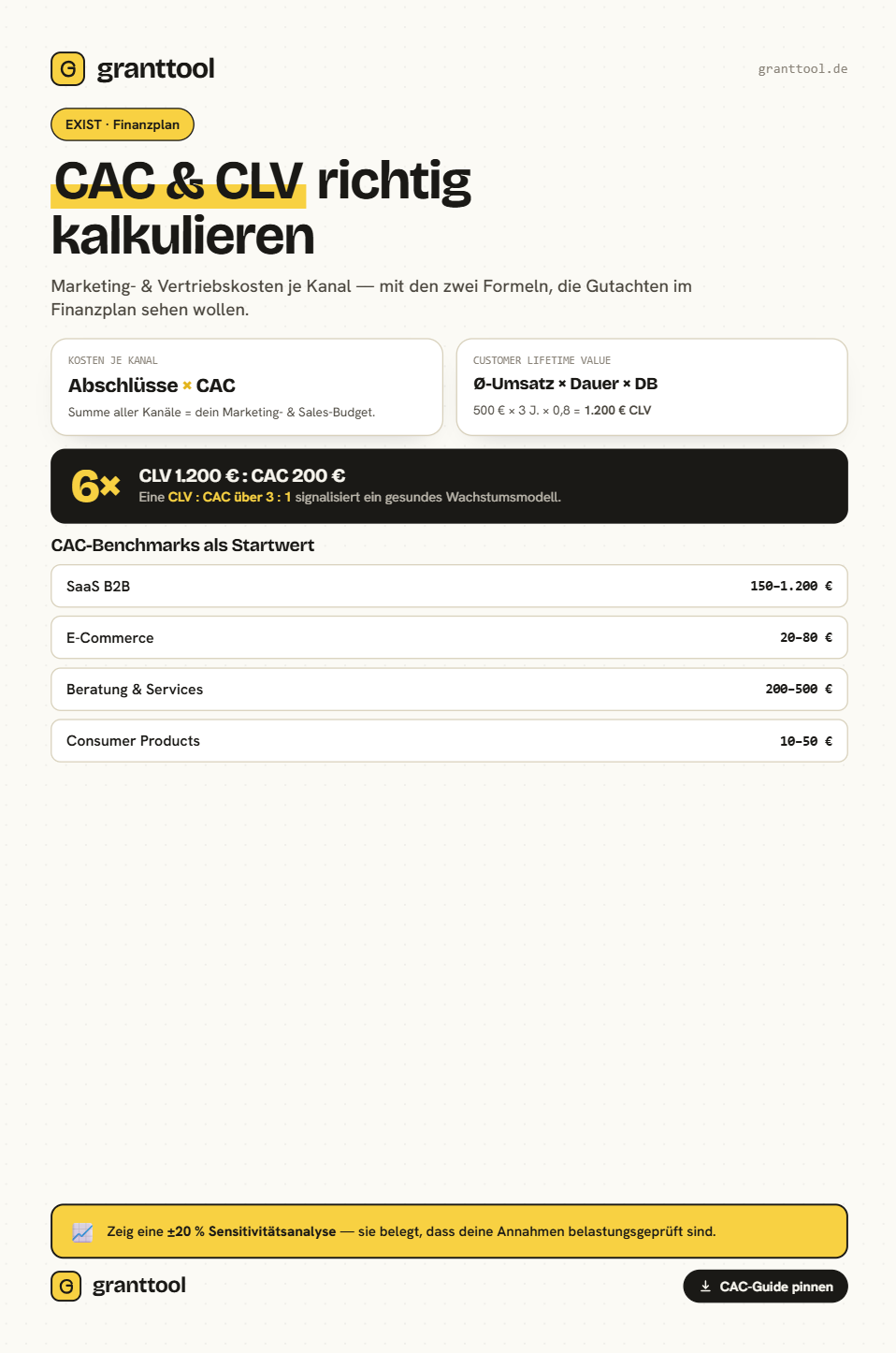
For each channel: annual cost K = planned sales volume V × CAC. The sum across all channels is your total marketing & sales spend. CAC components include software licences (CRM, outreach tools), staff costs, agency fees, travel, and content creation.
You can also calculate the Customer Lifetime Value: CLV = average annual revenue per customer U × average relationship duration D × contribution margin DB. Example: U = €500, D = 3 years, DB = 0.8 → CLV = €1,200. A CLV of €1,200 versus a CAC of €200 means each customer returns six times the acquisition cost – a strong argument for a scalable growth strategy.
4. Industry benchmarks for CAC
Published benchmarks: SaaS B2B €150–1,200 (Gartner / Hockeystack), e-commerce €20–80 (Shopify), consulting & services €200–500, consumer products €10–50 (eMarketer). If no benchmark matches your vertical, use your own pilot data and label it as 'early pilot CAC, expected to improve with scale'.
The two formulas and the benchmarks at a glance
Both formulas reviewers want to see — cost per channel = closings × CAC, and CLV = average revenue × duration × contribution margin — plus the CLV:CAC ratio that signals a healthy model and the per-industry CAC benchmarks, all on one page. A CLV of €1,200 against a CAC of €200 means each customer returns six times the acquisition cost.
 Download
5. Worked example – Year 3
Assume: 400 sales via referrals (CAC €0, total €0), 500 via trade shows (CAC €500, total €250,000), 1,000 via digital ads (CAC €4.45, total €4,450), 600 via cold outreach (CAC €8, total €4,800). Grand total for Year 3: 2,500 customers, €259,250 marketing & sales spend. Show a ±20% sensitivity analysis to demonstrate your assumptions are stress-tested.

FAQ
Frequently asked
Try Grants
Free plan, no credit card. We host in Germany. You can export and delete everything self-serve.
Written by
Julia Yukovich
Co-Founder + CEO
Julia is one of the Co-Founders. She handles design, development, product direction, and most of the support replies that arrive in the morning.
Read next
5 common mistakes in the EXIST application – and how to avoid them
A practical checklist before you submit.
Read
How long an EXIST Gründerstipendium really takes (the honest 4-5 month timeline)
What every week of an EXIST application costs you - and what you can shorten.
Read
Building the EXIST Finanzplan: stipend, Sachkosten, Coaching, and the line items reviewers question
What EXIST actually pays, what it does not, and how to itemise Sachkosten.
Read